USAID DEC
The impact of household food security on micro-level communal conflict in Eastern Democratic Republic of Congo
Sign inTEXAS A&M INTERNATIONAL UNIVERSITY
The impact of household food security on micro-level communal conflict in Eastern Democratic Republic of Congo
Household food security has been linked to a reduction in micro-level communal conflict in Eastern Democratic Republic of Congo.
48 pages
Sign in to readA free account is required to download.
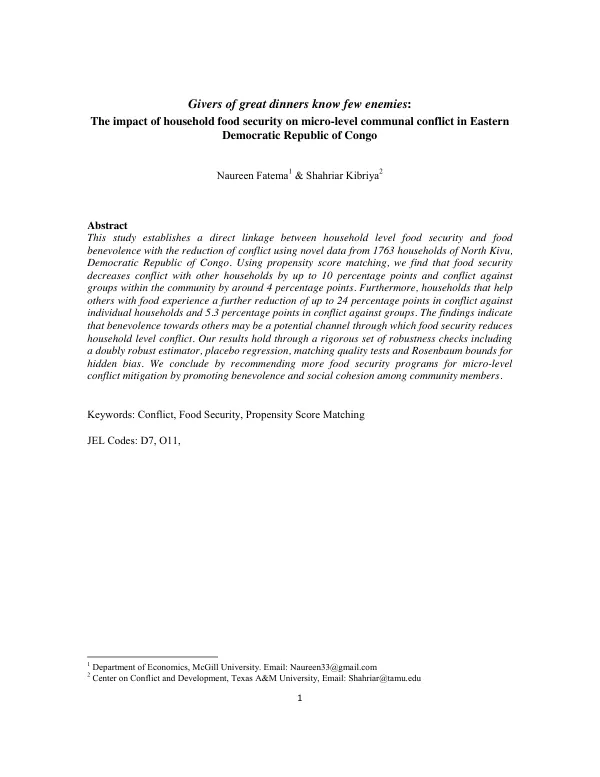
Abstract
A study conducted by Naureen Fatema and Shahriar Kibriya used novel data from 1763 households in North Kivu, Democratic Republic of Congo, to establish a direct linkage between household level food security and food benevolence with the reduction of conflict. The study employed propensity score matching, a quasi-experimental estimation technique, to estimate the causal effects of food security on household level conflict. The results showed that food security decreases conflict with other households by up to 10 percentage points and conflict against groups within the community by around 4 percentage points. Furthermore, households that help others with food experience a further reduction of up to 24 percentage points in conflict against individual households and 5.3 percentage points in conflict against groups. The study also found that food secure households that assist others with food experience a further reduction in conflict, indicating that benevolence towards others may be a potential channel through which food security reduces household level conflict. The findings were robust to a range of sensitivity checks, including a doubly robust estimator, placebo regression, matching quality tests, and Rosenbaum bounds for hidden bias. The study's results have implications for conflict mitigation policies, suggesting that promoting food security and benevolence among community members may be an effective way to reduce micro-level communal conflict. The study's findings also highlight the importance of considering household and community level violence in the study of food security and conflict. The study's context is the Democratic Republic of Congo, one of the seven countries in the world that make up sixty-five percent of the world's food insecure people. The country has a history of conflict and inequality, making it an ideal setting to study the relationship between food security and conflict. The study's use of primary survey data from 1763 households in North Kivu, Democratic Republic of Congo, provides a unique perspective on the micro-foundational linkage between food security and conflict. The study's methodology involved employing propensity score matching to estimate the causal effects of food security on household level conflict. The study also used a range of sensitivity checks to ensure the robustness of the findings. The study's results provide evidence of food benevolence as a possible behavioral pathway through which food security may reduce household level conflict.