USAID
The Impact of Legal Restrictions on Media in Tanzania
The Impact of Legal Restrictions on Media in Tanzania began with the passage of restrictive media laws in 2016 and 2018.
2023 · 2 pages
Sign in to readA free account is required to download.
Abstract
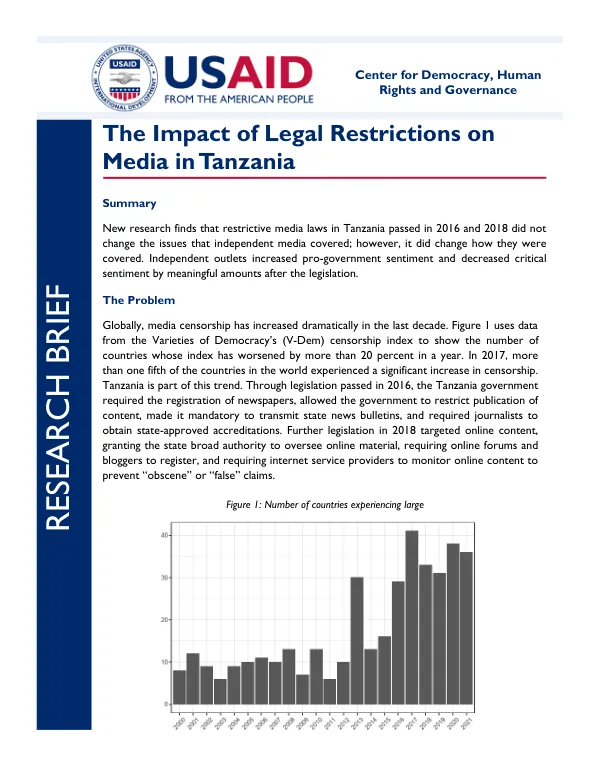
These laws required the registration of newspapers, allowed the government to restrict publication of content, mandated the transmission of state news bulletins, and required journalists to obtain state-approved accreditations. Further legislation in 2018 targeted online content, granting the state broad authority to oversee online material, requiring online forums and bloggers to register, and requiring internet service providers to monitor online content to prevent "obscene" or "false" claims. Independent media sources in Tanzania responded to these censorship efforts by changing the content of their news articles. Research conducted by the Center for Democracy, Human Rights and Governance found that independent news sources did not decrease the amount of coverage of protests, arrests, and censorship relative to government-affiliated newspapers. However, they did decrease their critical coverage of the government and increase their positive coverage. Prior to the legal change, independent outlets were 7.9 percent more likely to publish a critical government article, but this difference declined to 3.3 percent after the legal changes. This decline is substantively large, given that only 13.5 percent of all articles published by independent outlets have a critical tone. The study also found that independent outlets were 12 percent less likely to publish a pro-government article before the restrictions, but this gap diminished to 4.4 percent after 2018. This suggests that the restrictive media laws in Tanzania have had a negative impact on independent journalism, leading to a decrease in critical coverage and an increase in pro-government sentiment. The research team used machine learning to identify articles and code the sentiment as part of a larger Machine Learning for Peace initiative. The findings of this study have implications for media freedom and the protection of journalists targeted by restrictive media laws. The research demonstrates that media censorship laws can have a significant impact on the content and sentiment of media coverage, leading to a decrease in critical coverage and an increase in pro-government sentiment. This suggests that USAID should continue its efforts to support media and civil society organizations in advocating for media freedom and protecting journalists targeted by such laws. The study's findings are based on a comparison of the coverage of protests, arrests, and censorship by two independent news sources and two state media sources before and after legislative changes. The research team used machine learning to identify articles and code the sentiment, providing a comprehensive analysis of the impact of restrictive media laws on media coverage in Tanzania. The study's findings highlight the need for continued support for media freedom and the protection of journalists in Tanzania and other countries where restrictive media laws are in place.