USAID DEC
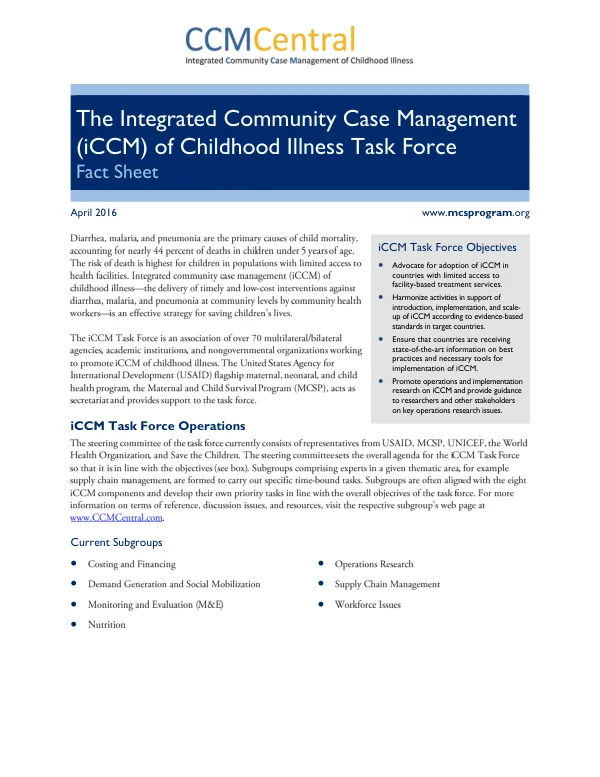
The Integrated Community Case Management (iCCM) of Childhood Illness Task Force Fact Sheet
Sign inJSI
The Integrated Community Case Management (iCCM) of Childhood Illness Task Force Fact Sheet
The iCCM Task Force is an association of over 70 multilateral/bilateral agencies, academic institutions, and nongovernmental organizations working to promote Integrated Community Case Management (iCCM) of childhood illness.
2016 · 2 pages
Sign in to readA free account is required to download.
Abstract
The primary causes of child mortality, accounting for nearly 44 percent of deaths in children under 5 years of age, are diarrhea, malaria, and pneumonia. The risk of death is highest for children in populations with limited access to health facilities. iCCM is an effective strategy for saving children's lives, involving the delivery of timely and low-cost interventions against diarrhea, malaria, and pneumonia at community levels by community health workers. The iCCM Task Force aims to advocate for the adoption of iCCM in countries with limited access to facility-based treatment services, harmonize activities in support of introduction, implementation, and scale-up of iCCM, and ensure that countries receive state-of-the-art information on best practices and necessary tools for implementation. The iCCM Task Force has established a steering committee consisting of representatives from USAID, MCSP, UNICEF, the World Health Organization, and Save the Children. The steering committee sets the overall agenda for the iCCM Task Force, aligning it with the objectives. Subgroups comprising experts in specific thematic areas, such as supply chain management, are formed to carry out specific time-bound tasks. These subgroups are often aligned with the eight iCCM components and develop their own priority tasks in line with the overall objectives of the task force. CCMCentral.com serves as the knowledge management portal of the task force, centralizing resources, providing access to a wide range of implementation tools, and offering numerous examples of best and promising practices. The iCCM Benchmarks Framework is a tool for program planners and managers to systematically design and implement iCCM programs from the early phases through to expansion and scale-up. The iCCM indicators are a compendium of 10 global and 38 country-level indicators that countries can choose from to monitor national iCCM programs. The iCCM Task Force has contributed to several publications about iCCM, helping to summarize and consolidate evidence for this important strategy. These publications include a supplement addressing iCCM as a strategy to alleviate poverty, a two-page summary from the 2014 iCCM Evidence Review Symposium, and a journal issue focused on findings from the 2014 iCCM Evidence Review Symposium.
Related documents