JSI
Quarterly Report: January 1st to March 31st, 2015
The Maternal and Child Survival Program (MCSP) in Uganda, a USAID-funded project, aims to strengthen the institutional and technical capacity of the Uganda National Expanded Programme on Immunization (UNEPI) to plan, coordinate, manage, and implement immunization activities at the national level.
2015 · 11 pages
Sign in to readA free account is required to download.
Abstract
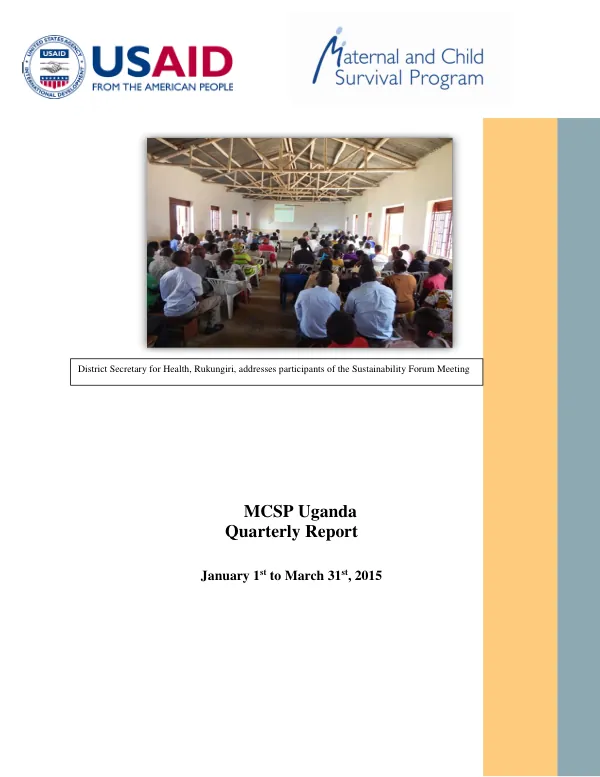
The project also seeks to improve district capacity to manage and coordinate the immunization program as guided by UNEPI leadership. During the reporting period of January 1st to March 31st, 2015, significant progress was made towards achieving the project's objectives. The recruitment for the National Technical Advisor was successfully completed, with Constantine Kiddaga selected for the position. Kiddaga and the newly hired ME&L Advisor, Timothy Kiyemba, were oriented to JSI, MCSP, and past work done through MCHIP Uganda, as well as on the Reaching Every Child with Quality Improvement (REC-QI) methodology. The Bill & Melinda Gates Foundation awarded the Stronger Systems for Routine Immunization (SS4RI) project in Uganda to JSI, and Dr. Gerald Ssekitto was named as Chief of Party for both projects. This leadership will ensure technical coherence between the two projects. A joint-project orientation was held with all staff in February, and the MCSP Office absorbed SS4RI staff and management processes were established to co-share resources as relevant. The transition from MCHIP to the Maternal and Child Survival Program (MCSP) was successfully presented and discussed with MOH/UNEPI, and acceptance for the new award was granted during the meeting. The Program Monitoring Plan (PMP) was drafted and is ready for submission in Q3. MCSP is currently finalizing baseline data collection tools, and USAID/Kampala has agreed to accept submission of the draft PMP without baseline data and targets; it will be updated when data are available next quarter. The COP jointly presented the REC-QI Uganda work at the World Congress on Public Health, Kolkata India, and the MCSP National Technical Director participated in the WHO/UNICEF East and Southern African EPI Managers' Meeting in Livingstone Zimbabwe in March. The REC-QI work in Uganda and Ethiopia was presented and discussed, and the presentation of REC-QI work at such fora not only shares best practices with the approach but also has the potential to improve its implementation by incorporating inputs from colleagues. The MCSP supported MOH/UNEPI to review and revise the Immunization in Practice (IIP) manual for both pre-service and in-service training of health workers. With support from MCSP, MOH/UNEPI engaged a consultant and selected a working committee (comprised of immunization partners and UNEPI staff) to review the revised IIP materials, which will include aspects of the REC-QI approach. The final, revised IIP materials are due to be ready by June 2015. The MCSP supported UNEPI and the Health Journalist Network to advocate for donor funding to support ongoing publication of the quarterly pullout with EPI data from all districts in the New Vision newspaper. Initial interest from New Vision Publications has been encouraging. The MCSP technically supported MOH/UNEPI in organizing and facilitating the multi-partner EPI review in February-March 2015. MCSP's National Technical Director, Constantine Kiddaga, participated in the review and assisted in the development of the tools that it used. The MCSP supported Kapchorwa district to hold its integrated district Quarterly Review Meeting (QRM) of health activities, including review of quality improvement-PDSA cycles on January 29, 2015. Similar meetings were supported in February in Iganga with 144 participants and in Busia with 108 participants. During QRMs, districts review local data to assess performance against EPI targets, identify reasons why targets were or were not met, and plan for improvements to help reach those targets. The MCSP successfully supported a sustainability forum meeting with Rukungiri district on March 10, 2015. The sustainability forum meeting was attended by 143 participants, including the Deputy Program Manager from UNEPI, regional support supervision team representatives, district and sub-county leaders, all health facility in-charges, and MCSP staff. During the meeting, the District Health Officer (DHO) reviewed where the district was before the MCSP support, progress achieved in association with REC-QI implementation, current performance, and plans to sustain the achievements. The MCSP will conduct a review in Kapchorwa to identify gaps in REC-QI uptake and reasons for them. The assessment approach was drafted during Q2 and will be implemented during Q3. The MCSP will also support Kabale, Iganga, and Busia districts to hold sustainability forum meetings.
Related documents