USAID DEC
The Integrated Health Project Plus (IHPplus) in the Democratic Republic of the Congo
Sign inMANAGEMENT SCIENCES FOR HEALTH
The Integrated Health Project Plus (IHPplus) in the Democratic Republic of the Congo
The Integrated Health Project Plus (IHPplus) was implemented in the Democratic Republic of Congo (DRC) from June 2015 to June 2018.
2018 · 7 pages
Sign in to readA free account is required to download.
Abstract
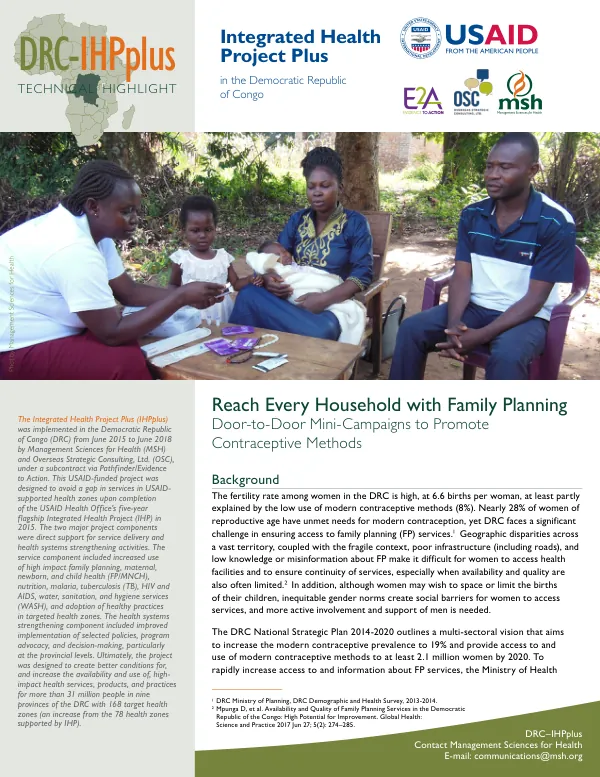
The project was designed to avoid a gap in services upon completion of the USAID Health Office's flagship Integrated Health Project (IHP) in 2015. The project aimed to increase the availability and use of high-impact health services, including family planning, maternal, newborn, and child health, nutrition, malaria, tuberculosis, HIV and AIDS, water, sanitation, and hygiene services, and healthy practices in targeted health zones. The project had two main components: direct support for service delivery and health systems strengthening activities. The service component included increased use of high-impact family planning, maternal, newborn, and child health, nutrition, malaria, tuberculosis, HIV and AIDS, water, sanitation, and hygiene services, and adoption of healthy practices in targeted health zones. The health systems strengthening component included improved implementation of policies, program advocacy, and decision-making, particularly at the provincial level. The DRC Ministry of Health introduced an approach that engages community-based distributors (CBDs) of family planning services. CBDs are authorized to provide oral contraceptive pills and Implanon NXT through a pilot program. Sayana Press is being scaled up, and policy change for provision of this method by CBDs is underway. Despite the potential for CBDs to improve access to family planning services, the limited numbers of CBDs per population and their low motivation hinder the full potential of this approach. The USAID-funded Integrated Health Project Plus (IHPplus) sought to identify innovative means to reach households with family planning services. The project adapted the DRC's field-tested approach to vaccination campaigns to family planning. Three-day mini-campaigns were designed to mobilize communities around family planning, provide door-to-door services, and link women and men to CBDs while supporting and motivating the CBDs. The strategy aimed to enable CBDs to talk with couples and engage men in counseling and awareness sessions. The mini-campaigns were conducted in 66 targeted sites across 6 provinces, with a focus on communities with limited or no access to family planning services. The campaigns were organized by IHPplus, the National Reproductive Health Program, and provincial and zonal health staff. The campaigns included training for providers, community mobilization, and the provision of tools and supplies. During the campaign, the CBDs passed through the streets and high-traffic areas to announce the imminent arrival of the CBDs and spread family planning information. The CBDs offered educational sessions, counseling sessions, and short-term family planning methods, including pills, injectables, implants, intrauterine devices, and cycle beads. Referrals were made for clients interested in other methods to a health center or a fixed site set up in the community and staffed by a nurse. Supervisors assigned to each health area used checklists to ensure quality, provide clarifications to the CBDs or clients as needed, and monitor availability of commodities and supplies. Daily sessions were held to assess the successes and plan for the following day. Follow-up was conducted by the CBDs to identify and revisit clients in their catchment area, discuss method side effects or switching methods, and provide counseling and strengthen relationships with the CBDs. The IHPplus project implemented the mini-campaigns in 66 health areas selected from 16 health zones in 6 provinces. These sites were selected based on indicators of access and utilization of family planning services. The selected health areas had an average population of 14,883, with populations ranging from 4,914 to 44,877. Campaign data were collected by the CBDs and providers at community sites and reported to the National Reproductive Health Program.