MANAGEMENT SCIENCES FOR HEALTH
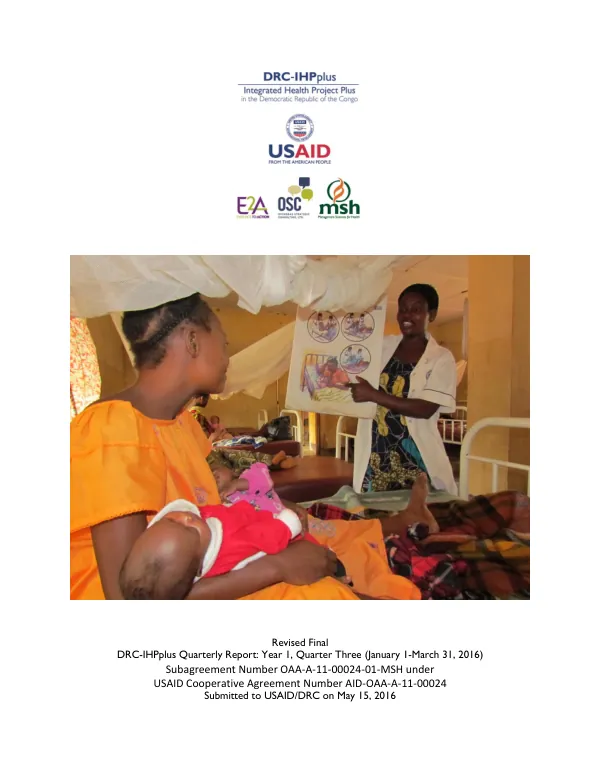
DRC-IHPplus Year One Quarter Three Report: January 1-March 31, 2016
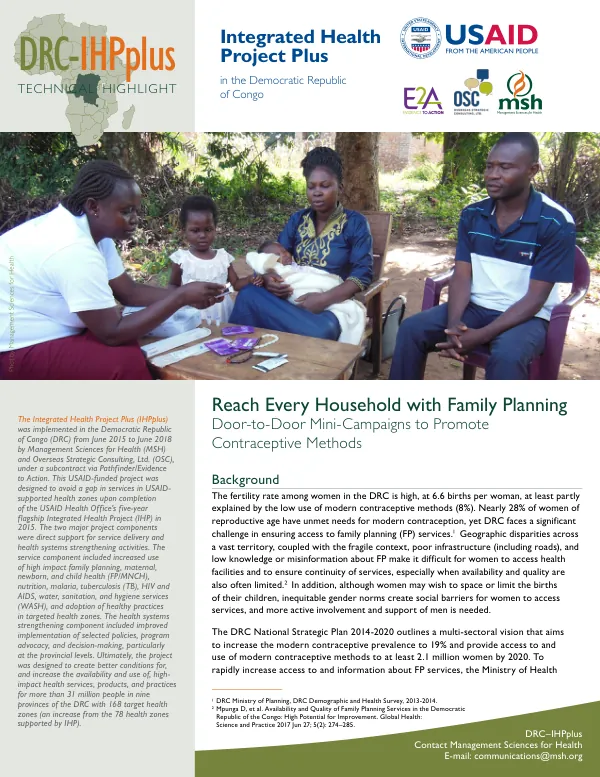
The Integrated Health Project Plus (IHPplus) in the Democratic Republic of Congo (DRC) is a two-year project implemented by Management Sciences for Health (MSH) and Overseas Strategic Consulting, Ltd (OSC) under a subcontract via Pathfinder/Evidence to Action (E2A).
2016 · 283 pages
Sign in to readA free account is required to download.
Abstract
The project is funded by the United States Agency for International Development (USAID) and aims to strengthen the country's health system at every level. IHPplus addresses "Services" and "Other Health Systems" to create better conditions for, and increase the availability and use of, high-impact health services, products, and practices in 83 health zones. The project focuses on eight Divisions Provinciales de Santé (DPS): 1) Kasaï; 2) Kasaï Central; 3) Lomami; 4) Kasaï Oriental; 5) Sankuru; 6) Haut Lomami; 7) Lualaba; and 8) Sud Kivu. IHPplus provides varying levels of effort and support to 1,562 health facilities: 1,479 health centers and 83 general referral hospitals (GRHs) in 83 health zones. The project maintains its project office in Kinshasa to facilitate communication with the DRC Ministry of Health (MOH), other host government authorities, and USAID. IHPplus has eight coordination offices to facilitate activity implementation at the field level. These offices are located in Bukavu, Kamina, Kolwezi, Lodja, Luiza, Mwene Ditu, Tshumbe, and Uvira. Each coordination office covers a specific cluster of health zones, with Bukavu representing 27 health zones, Kamina representing 9 health zones, and the remaining offices representing 7-10 health zones each. The project's main goal is to improve health services for the Congolese population, particularly in the areas of maternal, newborn, and child health (MNCH). IHPplus aims to increase access to and availability of high-impact health services, products, and practices in the target health zones. The project also focuses on strengthening the health system at every level, including the Ministry of Health, provincial health authorities, and health facilities. IHPplus has made significant progress in the first year of implementation. The project has established a strong presence in the target health zones, with a team of experienced staff and a well-organized coordination system. The project has also made significant progress in improving health services, including the expansion of antenatal care, skilled birth attendance, and emergency obstetric care. In terms of specific achievements, IHPplus has reported the following: * 83 health zones have been established, with a total of 1,562 health facilities receiving support. * 1,479 health centers and 83 general referral hospitals (GRHs) have been supported. * The project has established a strong coordination system, with eight coordination offices covering the target health zones. * IHPplus has made significant progress in improving health services, including the expansion of antenatal care, skilled birth attendance, and emergency obstetric care. * The project has also made significant progress in strengthening the health system at every level, including the Ministry of Health, provincial health authorities, and health facilities. Overall, IHPplus has made significant progress in the first year of implementation, and the project is well-positioned to achieve its goals and objectives in the coming years.
Related documents