MANAGEMENT SCIENCES FOR HEALTH
DRC-IHP Quarterly Report: January-March 2011
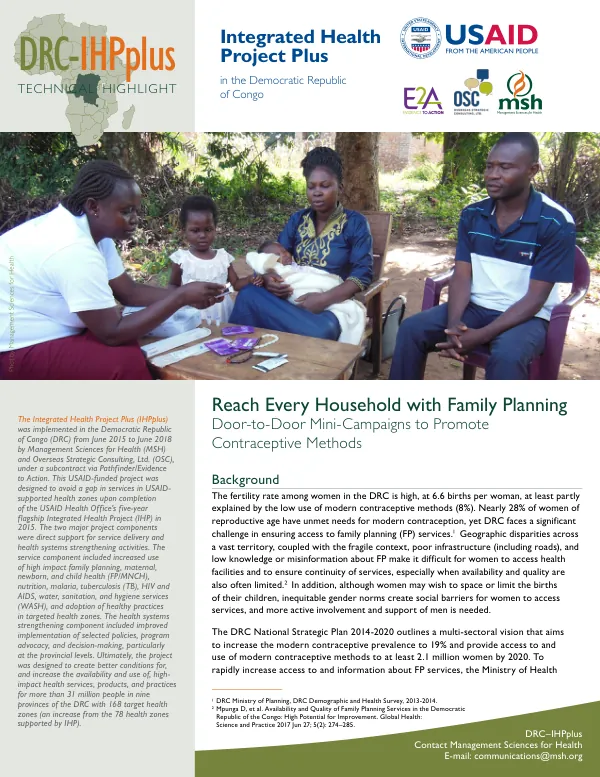
The Integrated Health Project (IHP) in the Democratic Republic of the Congo (DRC) is a five-year initiative funded by the United States Agency for International Development (USAID).
2011 · 137 pages
Sign in to readA free account is required to download.
Abstract
The project's primary objective is to improve the enabling environment for and increase the availability and use of high-impact health services, products, and practices in 80 target health zones in four provinces of DRC. The project's goal is to enhance the health status of the population, particularly in the areas of family planning, maternal, newborn, and child health, nutrition, malaria, and tuberculosis. The project is divided into two components: Component 1, "Services," and Component 2, "Other Health Systems." Component 1 focuses on increasing access to and availability of the Minimum Package of Activities (MPA) and Complementary Package of Activities (CPA-PLUS) services in the target health zones. This component aims to improve the quality of MPA/CPA-PLUS services, increase knowledge, attitudes, and practices (KAP) to support health-seeking behaviors, and enhance the leadership and governance of the health sector in the target provinces. Component 2, "Other Health Systems," focuses on strengthening the health systems in the target provinces. This component aims to improve the leadership and governance of the health sector, enhance the management of health services, and increase the availability and use of high-impact health services, products, and practices. The project's implementation is led by Management Sciences for Health (MSH), in partnership with the Ministry of Health (MOH) and other stakeholders. The project's progress is monitored through a Performance Monitoring Plan (PMP), which tracks key indicators and outcomes. During the second quarter of the first year (January-March 2011), the project made significant progress in implementing its activities. Component 1 achieved notable results, including an increase in the availability and use of MPA/CPA-PLUS services in the target health zones. Component 2 also made progress in strengthening the health systems in the target provinces. The project's success is attributed to the strong partnership between MSH, the MOH, and other stakeholders. The project's progress is also facilitated by the availability of resources, including funding and technical assistance. However, the project faces challenges, including the need for further strengthening of the health systems and the availability of resources. The project's next quarter (April-June 2011) will focus on consolidating the gains made during the second quarter and addressing the challenges faced by the project. The project will continue to work closely with the MOH and other stakeholders to ensure the successful implementation of its activities. The project's overall goal is to improve the health status of the population in the target health zones. The project's success will depend on the effective implementation of its activities, the availability of resources, and the strong partnership between MSH, the MOH, and other stakeholders. In terms of specific achievements, the project reported an increase in the availability and use of MPA/CPA-PLUS services in the target health zones. The project also reported an improvement in the quality of MPA/CPA-PLUS services, as well as an increase in knowledge, attitudes, and practices (KAP) to support health-seeking behaviors. The project's progress is monitored through a Performance Monitoring Plan (PMP), which tracks key indicators and outcomes. The PMP includes indicators such as the availability and use of MPA/CPA-PLUS services, the quality of MPA/CPA-PLUS services, and the knowledge, attitudes, and practices (KAP) of the population.
Related documents