USAID DEC
The Legality of Customary Land Documents Within the Existing Formal Legal System in Zambia
Sign inTETRA TECH
The Legality of Customary Land Documents Within the Existing Formal Legal System in Zambia
Customary land documentation in Zambia has remained elusive with a general understanding that whatever is customary is usually not written and remains undocumented.
2017 · 18 pages
Sign in to readA free account is required to download.
Abstract
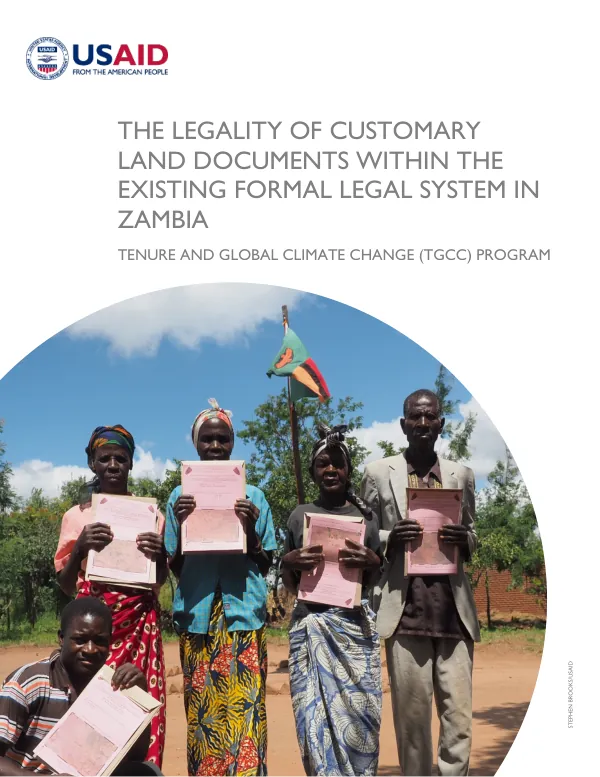
This has led to insecurity of tenure further leading to conflicts and disputes in determining boundaries to the extent of one's land. In order to improve security of tenure, the documentation of customary rights has been promoted in Zambia, and increasingly across a range of countries. Prior to the Zambia Lands Act of 1995, the documentation of customary rights was proposed by Mulimbwa (1993, cited in Mulolwa, 2006) as an important evidence base for individual, communal, and concurrent rights. Registration and documentation of customary land in Zambia has taken a hype in recent years, considering the global rush for land, especially in Africa. This has led to a sense of awareness for customary landholders that there is a need to secure their land. A number of donor-funded projects have assisted in this registration and documentation. It has been proposed that registering customary land reduces conflicts as it clearly spells out the boundaries and extent of one's land, and documents a legal holding of land either individually or collectively. The Lands Act (Cap 184, s7 (2)) provides for the recognition of customary tenure within the formal legal system. Customary tenure refers to land rights that are allocated and controlled according to traditional practices. Lawyers, judges, and academics interviewed under this research were split in their judgment as to whether customary documents can be considered legal within the formal legal system. The general consensus is that a document which is not declared illegal by law is legal in that sense. However, some felt that in the absence of a legal framework explicitly providing for these documents, they remain worthless from a legal perspective. The majority of those interviewed felt that there is more that needs to be done to standardize and legitimize customary documents. One-third hinted that traditional leaders should continue issuing out these documents, but should have their capacity built and strengthened. Two-thirds of the respondents indicated that it is not enough to let traditional leaders alone issue out these documents, citing a lack of capacity, management, personnel, and skills to afford running such a mammoth task. They suggest that there is need to integrate traditional leaders and government departments, such as local authorities and line ministries involved in the management of land and traditional leadership. Examples of rights recognition tools that can be used to secure customary land rights include village titles, certificates or rights of occupancy, group ranches, flexible titles, land sharing constructions, customary rights issued by Land Boards, co-ownership, and communal titles. These models are piloted in Zambia amidst a gap in the legal framework to support the documents. The documentation of customary land will reduce conflicts and bring meaningful development to land, as indicated by Zambia Land Alliance (2013).
Related documents