USAID
Statutory Recognition of Customary Land Rights in Zambia
The Ministry of Lands, Natural Resources and Environmental Protection in Zambia undertook a review of the Draft National Land Policy 2006 between 2014 and 2018.
2018 · 9 pages
Sign in to readA free account is required to download.
Abstract
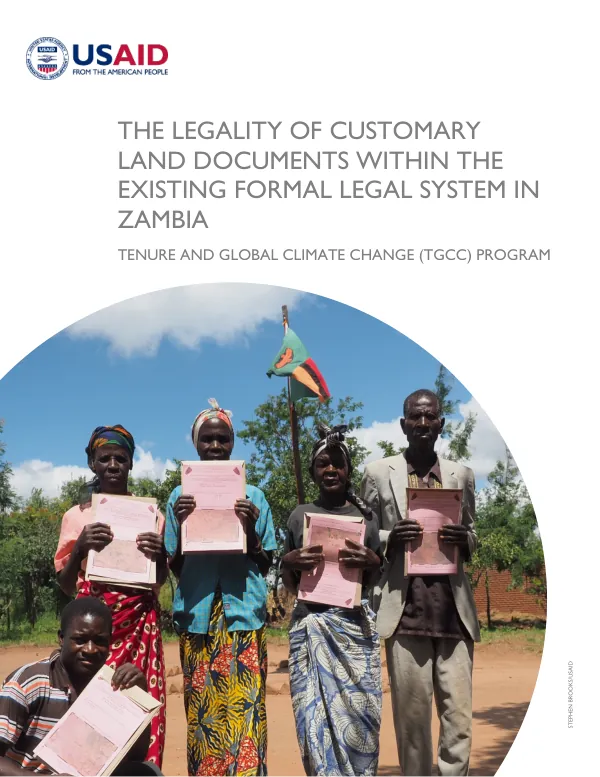
The review invited submissions from civil society organizations and other stakeholders on land policy matters. A key issue in the review was the weak legal status of rights to customary land compared to registered leasehold rights on state land. The document presents a case for strengthening customary land rights by providing for their full statutory recognition and according customary land rights a status equivalent to leasehold tenure, drawing on experience gained elsewhere in Southern Africa. Customary land in Zambia is held by individuals, families, clans, or communities from generation to generation. Residential and arable parcels are individually held, while rights to forest and grazing land are traditionally held communally. The commons constitute the greatest proportion of customary land, providing renewable natural resources such as fuel, edible wild plants, and insects. An important feature of customary tenure is the "right of avail," shared by community members, which does not depend on the discretion of the chief or headperson. Women, regardless of their marital status or age, can rarely acquire land or landed property on their own in much of the country. They may acquire land from deceased husbands as long as they do not remarry outside the family. There are variations in customs among different groups, including the Nsenga and Chewa tribes of Eastern Province, which have historically practiced matrilineal inheritance. Customary law permits the transfer of interests in residential land among members, but only with the consent of the chief and/or headperson. The current legal framework for customary land rights in Zambia has been subject to large-scale appropriation by the state. Customary land administration has yet to be regulated by statute, and a Customary Land Administration Bill has been expected since 2014 but has been awaiting full public consultation on a national land policy. The remaining area under customary tenure in Zambia in 2015 is uncertain, with estimates varying between 603 and 804 percent of the national territory. The reduction in the area of customary land is being driven by several factors, including the expansion of peri-urban areas, large-scale land acquisition for conservation, mining, tourism, and investment by international companies, and land speculation by foreigners and citizens. The process is at great cost to the poor, unable to contest such land claims in the absence of formally recognized rights to spatially defined areas of land and ready access to justice. Population growth and environmental degradation on customary land lead to decreasing food security and increasing migration to peri-urban areas, where residents in informal settlements on state land have limited rights under statutory law.