LAPOP
Travel Time to Critical Healthcare
The quality of a country's healthcare is often critical to its development.
2019 · 16 pages
Sign in to readA free account is required to download.
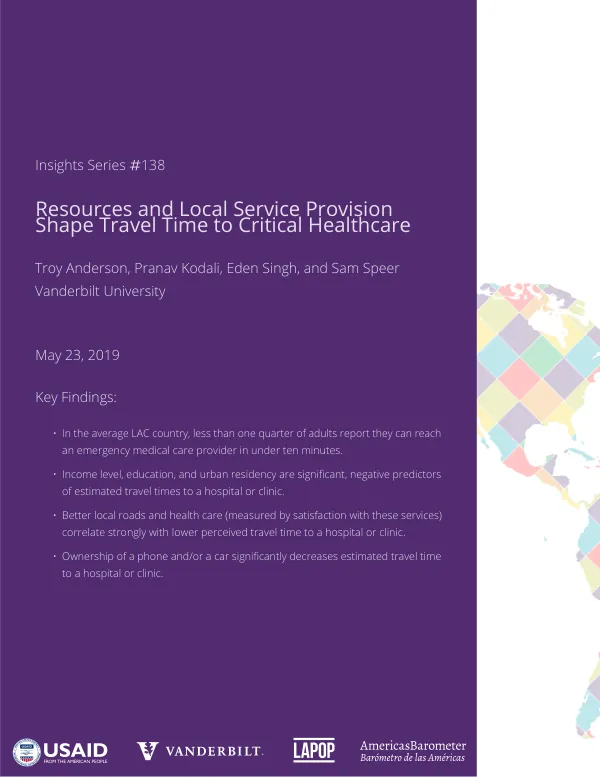
Abstract
When evaluating healthcare systems, scholars often look at factors such as medical services offered, density of hospitals, and economic accessibility of facilities. However, factors outside of the hospital are often overlooked when assessing the quality of medical services. Emergency medical transportation services are one such external factor that has been found to be inadequate or nonexistent in many places in the Americas. When emergencies arise, individuals in developed countries often rely on ambulance services, while those in less developed contexts are forced to rely on alternative forms of transportation due to deficits in such services. This can increase the amount of time it takes to get critical treatment, and those delays can have potentially fatal consequences. The Latin America and Caribbean (LAC) region-average distribution of responses to a survey question on estimated travel time to the nearest medical center or hospital in an emergency is displayed in Figure 1. The pie chart shows that nearly half (46%) of the population across the 20 LAC countries estimates that it would take between 10 and 30 minutes to get to the nearest medical center or hospital. The percentage falling into this 10 to 30 minute time interval for the average LAC country is not too different from that found in the AmericasBarometer surveys of the United States (50% reporting a travel time between 10 and 30 minutes) and Canada (53%). For the LAC region, the next two largest time intervals are less than 10 minutes and between 30 minutes and an hour, at 21.9% and 19.5%, respectively. Urban residency, higher education, and greater income are significant predictors of shorter estimated travel times to a hospital or clinic. This is consistent with standard LAPOP Insights reports, which predict individuals' responses to the travel time question with five socioeconomic and demographic factors: urban versus rural living environment, income, education, age, and gender. The regression results, displayed in Figure 2, show that urban residency, higher education, and greater income correlate with shorter estimated travel times, while older age is correlated with longer reported times. Gender is not statistically significant in the model. The results suggest that individuals in urban environments estimate significantly shorter times to get to a local hospital or clinic than those in rural areas. This is likely due to the larger density of population in urban areas, which results in hospitals being closer to the average person. Additionally, income is an important predictor of shorter hospital arrival times, as better-off individuals have greater access to private hospitals that provide transportation and better treatment. Education is also predictive of shorter perceived travel times, as higher education increases the likelihood that a person is aware of the healthcare services available. Age has a significant positive correlation with time it takes to get to the hospital or clinic, with every age group above the 25 and under age cohort perceiving longer hospital times than this younger group.