DEPARTMENT OF AGRICULTURE
The Magna Carta of Small Farmers: What’s in it for smallholders?
The Magna Carta of Small Farmers in the Philippines is a policy that aims to support the development of small farmers, who are considered a vital sector in the country's agricultural industry.
2009 · 4 pages
Sign in to readA free account is required to download.
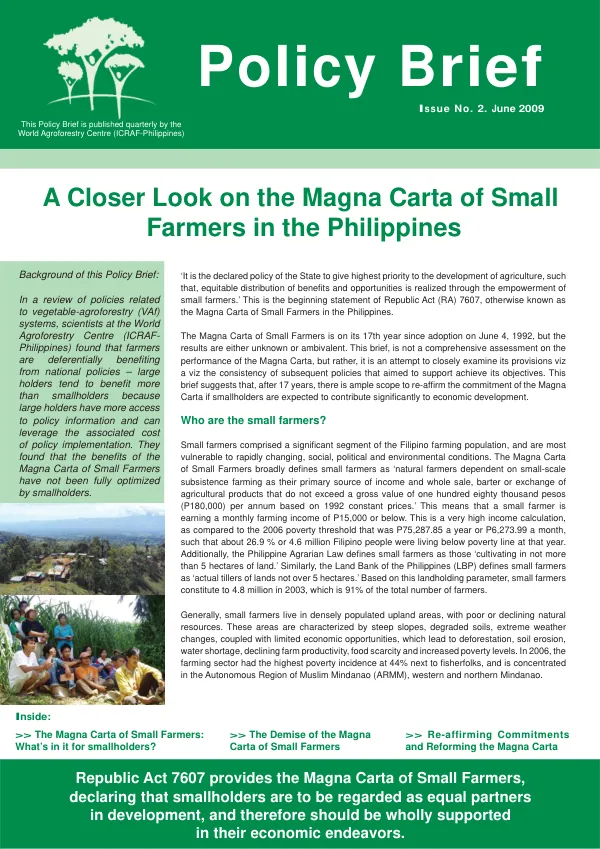
Abstract
The policy was enacted in 1992 through Republic Act 7607, which declares that small farmers are to be regarded as equal partners in development and should be wholly supported in their economic endeavors. Small farmers in the Philippines are defined as natural farmers who depend on small-scale subsistence farming as their primary source of income and have a gross value of agricultural products not exceeding P180,000 per annum. This means that small farmers earn a monthly farming income of P15,000 or below, which is a relatively high income calculation compared to the 2006 poverty threshold of P6,273.99 per month. The policy recognizes the importance of improving the lives of small farmers, who are most vulnerable to rapidly changing social, political, and environmental conditions. Small farmers are concentrated in densely populated upland areas, characterized by steep slopes, degraded soils, extreme weather changes, and limited economic opportunities. These areas are prone to deforestation, soil erosion, water shortage, declining farm productivity, food scarcity, and increased poverty levels. The Magna Carta of Small Farmers provides support to small farmers in several areas, including organization, empowerment, infrastructure and farm inputs, farm machinery and equipment, water management and irrigation facilities, agricultural credit, wage and incentives, and farmers' rights and obligations. The policy aims to assist small farmers in establishing self-help organizations, accessing infrastructure and farm inputs, and gaining access to irrigation services and agricultural credit. The government recognizes the importance of improving the lives of small farmers and has established several programs to support them. These programs include the provision of infrastructure support, access to farm inputs and services, and the establishment of an efficient rural credit delivery system. The policy also aims to empower small farmers by recognizing their rights to chart their own political and socio-economic developments. The Magna Carta of Small Farmers has been in effect for 17 years, but its results are either unknown or ambivalent. The policy suggests that there is ample scope to re-affirm the commitment of the Magna Carta if smallholders are expected to contribute significantly to economic development. The government has recognized the importance of improving the lives of small farmers and has established several programs to support them. The policy has several provisions that aim to support small farmers, including the organization of farmers, empowerment of small farmers, infrastructure and farm inputs, farm machinery and equipment, water management and irrigation facilities, agricultural credit, wage and incentives, and farmers' rights and obligations. The policy also recognizes the importance of improving the lives of small farmers and has established several programs to support them. The Magna Carta of Small Farmers has several provisions that aim to support small farmers, including the organization of farmers, empowerment of small farmers, infrastructure and farm inputs, farm machinery and equipment, water management and irrigation facilities, agricultural credit, wage and incentives