USAID DEC
Biodiversity and Watersheds Improved for Stronger Economy and Ecosystem Resilience (B+WISER)
Sign inDONG NAI PROVINCE DEPARTMENT OF NATURAL RESOURCES AND THE ENVIRONMENT
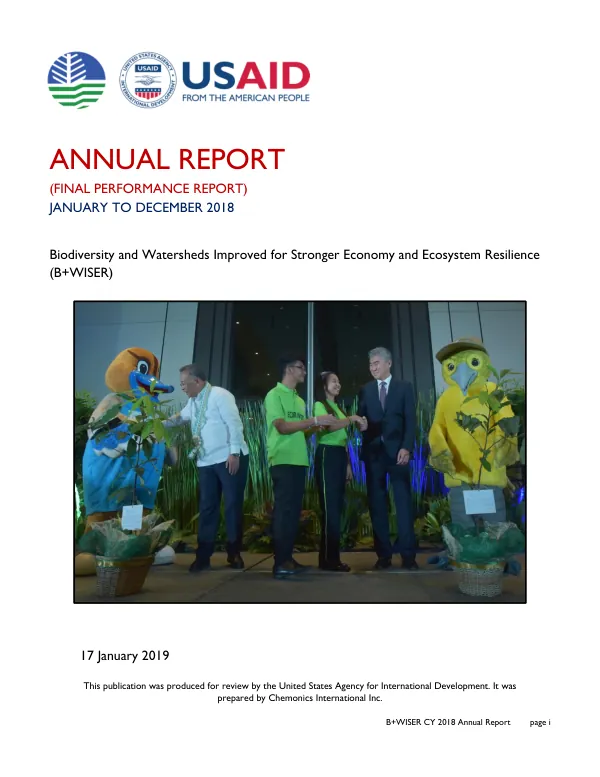
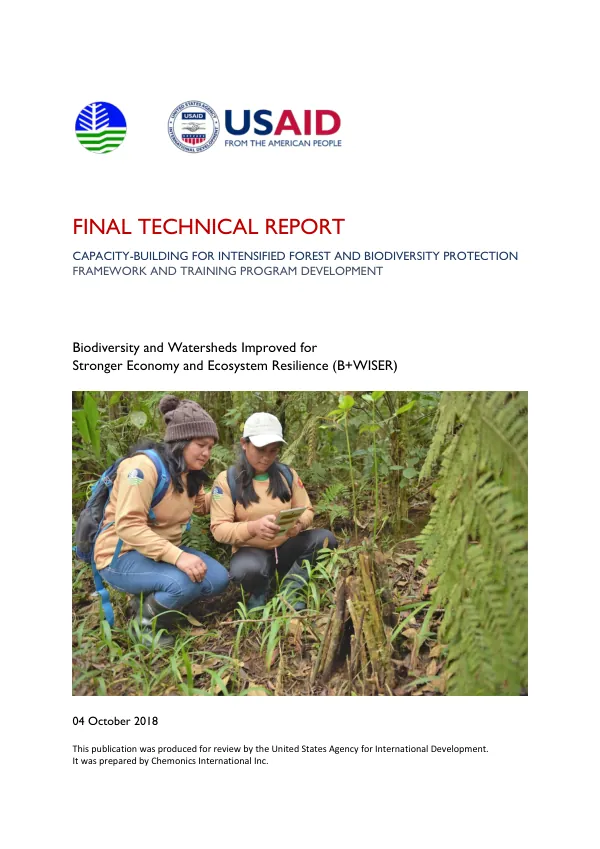
Biodiversity and Watersheds Improved for Stronger Economy and Ecosystem Resilience (B+WISER)
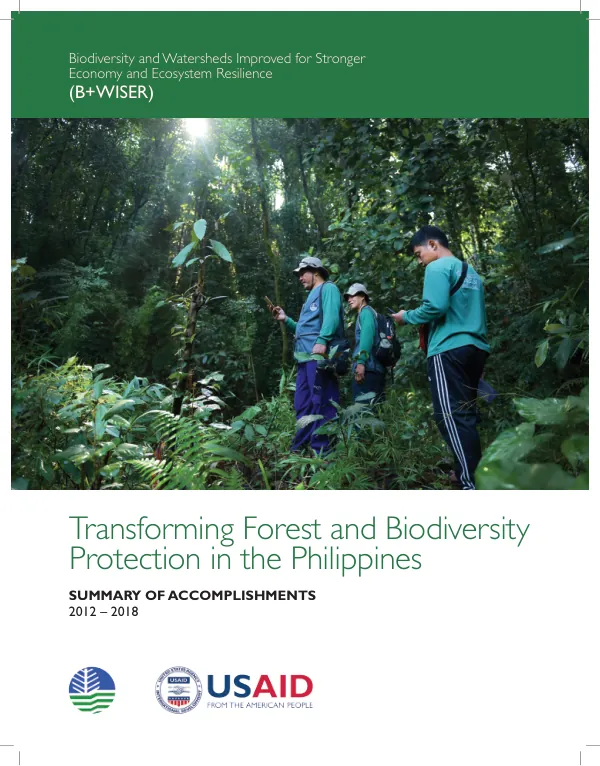
The Biodiversity and Watersheds Improved for Stronger Economy and Ecosystem Resilience (B+WISER) program was implemented in the Philippines from 2012 to 2018.
2018 · 20 pages
Sign in to readA free account is required to download.
Abstract
The program aimed to conserve biodiversity in forest areas, reduce forest degradation in priority watersheds, manage forests, monitor low emissions development, and increase capacities for biodiversity conservation and disaster resilience in vulnerable areas. The program was a partnership between the Department of the Environment and Natural Resources (DENR) and the United States Agency for International Development (USAID). B+WISER introduced a practical approach to forest and biodiversity protection, focusing on science-based conservation targets that used forest cover change assessments in forest conservation area planning. The program also coupled this approach with purpose-driven patrolling and improvements to responses to threats with simple written protocols. Implementation of the program focused on three key areas: conservation financing, policy and governance, and capacity building. The program leveraged several conservation finance options, including national budget allocations, payments for ecosystem services, and private sector investment. Staff engaged local community groups in active reforestation efforts and advanced passive restoration programs, increasing biodiversity for crucial upland forests and mangroves. The program also worked to improve environmental services, including recovery from and resilience to various stressors. B+WISER supported improvements in resilience by assessing vulnerabilities and including resilience considerations in land use and local development planning. The program's governance work improved environmental law enforcement and protected area management and local governments' use of partnerships and financing for more effective natural resource management. Through its work, the program contributed to transforming the way the Philippine government implements forest and biodiversity protection. B+WISER introduced a practical approach with a focus on science-based conservation targets that used forest cover change assessments in forest conservation area planning. The program also fostered ownership by enhancing the capacities of government agency staff in forest protection involved in planning, patrolling, responding to threats, managing data, and working with various groups to reduce pressures on the forests. The program's key results include the restoration of 700,000 hectares of degraded forests, the increase of economic benefits for 29,900 people from natural resource management and conservation, and the training of 10,000 people in natural resources management and sustainable landscapes. The program also leveraged US $51 million in investments from public and private sources for forest and biodiversity protection, resulting in the improvement of 600,000 hectares of forest biophysical condition and the reduction of 10 million metric tons of CO2 equivalent. The Lawin Forest and Biodiversity Protection System was a key component of the B+WISER program. Lawin was a science-based approach that applied forest cover change analysis to identify high conservation value areas and targets. Forest conservation area plans spelled out these targets, defining conservation objectives, desired future forest conditions, and management interventions to achieve them. This provided a sound basis for work prioritization, given limited resources. Lawin was piloted in 2014 at the seven original B+WISER program sites with a natural forest cover of around 380,000 hectares. In 2015, the system produced its first results in threat reduction. The practicality and simplicity of the system convinced the DENR in 2016 to make Lawin an integral part of the national forest and biodiversity protection strategy. DENR equipped and trained personnel throughout the country, allocated financial resources, and issued a policy to roll out the system nationwide, covering all of the 6.8 million hectares of the country's natural forests. Lawin enabled various members of society, including local communities, to collaborate in achieving their common goals to protect life on land and combat climate change. Stakeholder involvement in Lawin's development led to its broad acceptance by the Philippine government, schools and universities, and indigenous people living in the forests. These stakeholders participated in the system's implementation, viewing it as a way to turn around the country's forest and biodiversity conditions. The Lawin Forest and Biodiversity Protection System has been implemented in all 16 DENR regions, covering 166 forest conservation areas. It involves more than 3,000 forest patrollers, works with more than 350 data managers, and has recorded more than 175,000 kilometers of patrols. The system has stored more than 100 gigabytes of patrol data. Science-based planning was a key component of the B+WISER program. To determine high conservation value areas (HCVAs) in the forest, B+WISER applied science-based approaches, carrying out ecological modeling, forest cover change analysis, and forest threats assessment. This served to help the program better understand the forest condition, ecological values, and deforestation drivers, focusing interventions where they matter most. B+WISER promoted the inclusion of HCVAs, including sites sacred to indigenous peoples, along with measurable conservation targets, as enhancements to natural resource management planning. As a result, the program helped to enhance protected area management plans in the seven original program sites by integrating the HCVAs identified in the ecological assessments. Some local government units (LGUs) included HCV
Related documents