USAID DEC
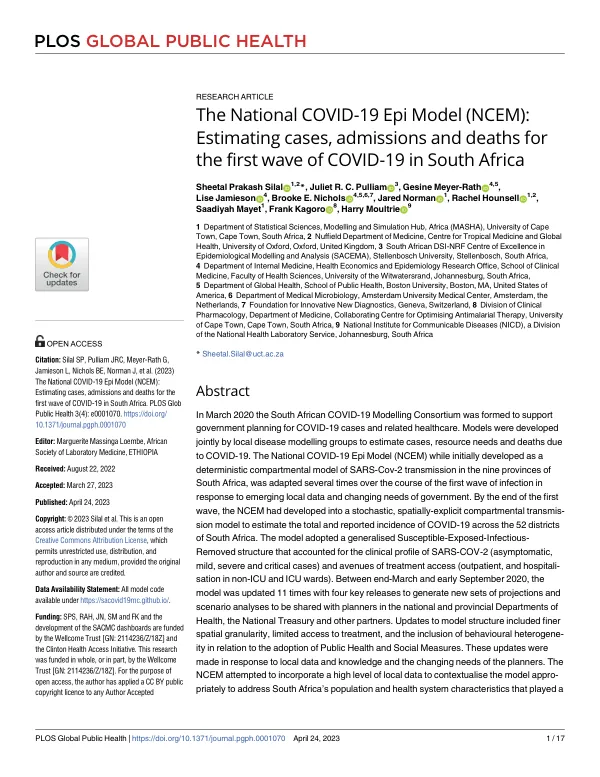
The National COVID-19 Epi Model (NCEM): Estimating cases, admissions and deaths for the first wave of COVID-19 in South Africa
Sign inCLINTON HEALTHCARE ACCESS INITIATIVE
The National COVID-19 Epi Model (NCEM): Estimating cases, admissions and deaths for the first wave of COVID-19 in South Africa
The National COVID-19 Epi Model (NCEM) was developed in March 2020 by a consortium of researchers from academic, non-profit, and government institutions in South Africa.
2023 · 17 pages
Sign in to readA free account is required to download.
Abstract
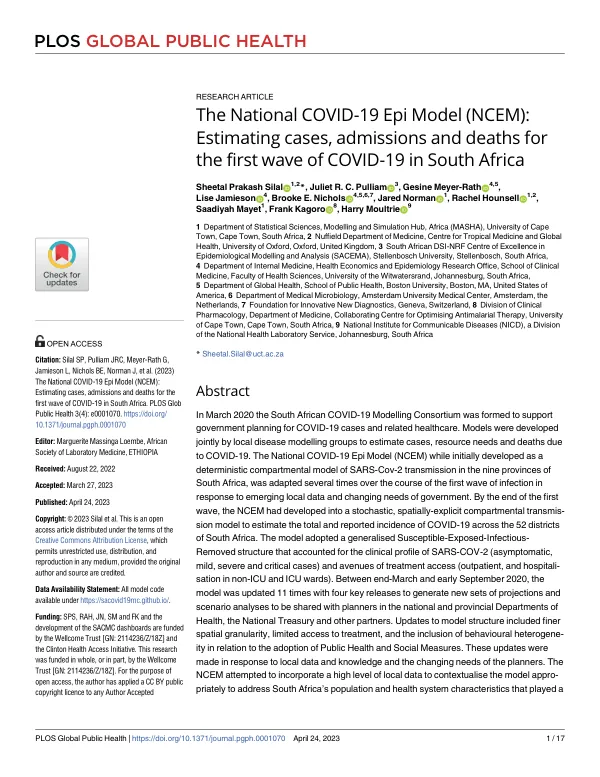
The model was designed to estimate cases, resource needs, and deaths due to COVID-19, and was initially developed as a deterministic compartmental model of SARS-CoV-2 transmission in the nine provinces of South Africa. The model was adapted several times over the course of the first wave of infection in response to emerging local data and changing needs of government. The NCEM adopted a generalised Susceptible-Exposed-Infectious-Removed structure that accounted for the clinical profile of SARS-CoV-2, including asymptomatic, mild, severe, and critical cases. The model also considered avenues of treatment access, including outpatient and hospitalisation in non-ICU and ICU wards. Between end-March and early September 2020, the model was updated 11 times with four key releases to generate new sets of projections and scenario analyses. The NCEM incorporated a high level of local data to contextualise the model appropriately to address South Africa's population and health system characteristics. The model was used to estimate the total and reported incidence of COVID-19 across the 52 districts of South Africa, and was shared with planners in the national and provincial Departments of Health, the National Treasury, and other partners. The model's updates included finer spatial granularity, limited access to treatment, and the inclusion of behavioural heterogeneity in relation to the adoption of Public Health and Social Measures. The NCEM was used to project cases, resource needs, and deaths, and to assess the extent to which these were impacted by emerging variants. The model's projections were used to inform policy decisions, and were shared with the South African government and other stakeholders. The NCEM's development and use highlighted the importance of harnessing and developing local modelling capacity, particularly in low- and middle-income countries. The COVID-19 pandemic brought to light the similarities in and differences between country approaches to epidemic decision-making and response. South Africa, in particular, had to balance a high baseline disease burden from other causes with the potential for economic contraction and existing demands on the healthcare system. The NCEM's development and use demonstrated the value of mathematical models in analysing the transmission and impact of infectious diseases, and in providing strategic information to support policy makers in programme and funding decisions. The NCEM's features and updates were designed to address the uncertainty surrounding SARS-CoV-2, including its prevalence, transmission, and the impact of non-pharmaceutical interventions. The model's use of local data and its adaptation to changing circumstances highlighted the importance of flexibility and responsiveness in modelling efforts. The NCEM's development and use also highlighted the need for collaboration and coordination between researchers, policymakers, and other stakeholders in responding to public health emergencies.