USAID DEC
Costs and cost-effectiveness of LEEP versus cryotherapy for treating cervical dysplasia among HIV-positive women in Johannesburg, South Africa
Sign inNORTH CAROLINA A&T STATE UNIVERSITY
Costs and cost-effectiveness of LEEP versus cryotherapy for treating cervical dysplasia among HIV-positive women in Johannesburg, South Africa
Cervical cancer incidence is significant in countries with high burdens of both HIV and human papillomavirus (HPV).
2018 · 13 pages
Sign in to readA free account is required to download.
Abstract
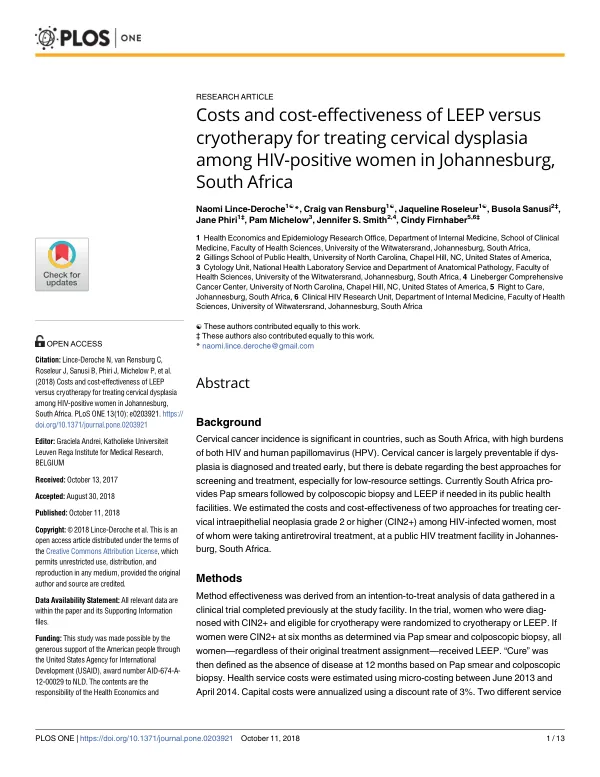
In South Africa, where HIV and HPV infection rates are among the highest globally, cervical cancer is the second most common cancer among women and results in the most cancer-related deaths. The national policy provides for free access to screening and treatment in the public sector, where roughly 80% of the population accesses healthcare. Cervical cancer is largely preventable if dysplasia is diagnosed and treated early. However, there is debate regarding the best approaches for screening and treatment, especially for low-resource settings. Currently, South Africa provides Pap smears followed by colposcopic biopsy and LEEP if needed in its public health facilities. LEEP is a loop electrosurgical excision procedure that involves the excision of the transformation zone of the cervix using a wire loop charged with electricity. An alternative approach used in many resource-poor settings globally is visual inspection with acetic acid (VIA) followed by cryotherapy. Cryotherapy involves the freezing of a lesion with a probe using nitrogen dioxide or carbon dioxide. This cryotherapy option allows for same-day diagnosis and treatment for women whose lesions do not extend to the endocervix or cover more than three-quarters of the cervix. LEEP must be available as backup for women with more significant lesions. A clinical trial conducted at a public HIV treatment facility in Johannesburg, South Africa, compared the efficacy of LEEP and cryotherapy for treating cervical intraepithelial neoplasia grade 2 or higher (CIN2+) among HIV-infected women. The trial involved 166 women with CIN2+, with 86 assigned to LEEP and 80 assigned to cryotherapy. At 12 months, cumulative loss to follow-up was 12.8% for the LEEP group and 13.8% for the cryotherapy group. The results of the intention-to-treat analysis showed no significant difference in efficacy between the two treatment groups. However, the as-treated analysis, which was based on trial data, showed that LEEP was more efficacious than cryotherapy, although the difference was not significant. Cryotherapy remained more cost-effective than LEEP in all sensitivity and scenario analyses. A cost-effectiveness analysis was conducted using an intention-to-treat approach and taking into consideration uncertainty in the clinical and cost outcomes. The results showed that a strategy involving cryotherapy plus LEEP if needed at six months was dominant to LEEP plus LEEP again at six months if needed for retreatment. However, compared to other studies comparing LEEP and cryotherapy, the efficacy results were low in both treatment groups, possibly due to the HIV-positivity of the participants. Further research is needed to determine the most effective and cost-effective treatment options for cervical dysplasia among HIV-positive women. However, at present, choosing the "right" treatment option may be less important than ensuring access to treatment and providing careful monitoring of treatment outcomes.
Related documents