USAID DEC
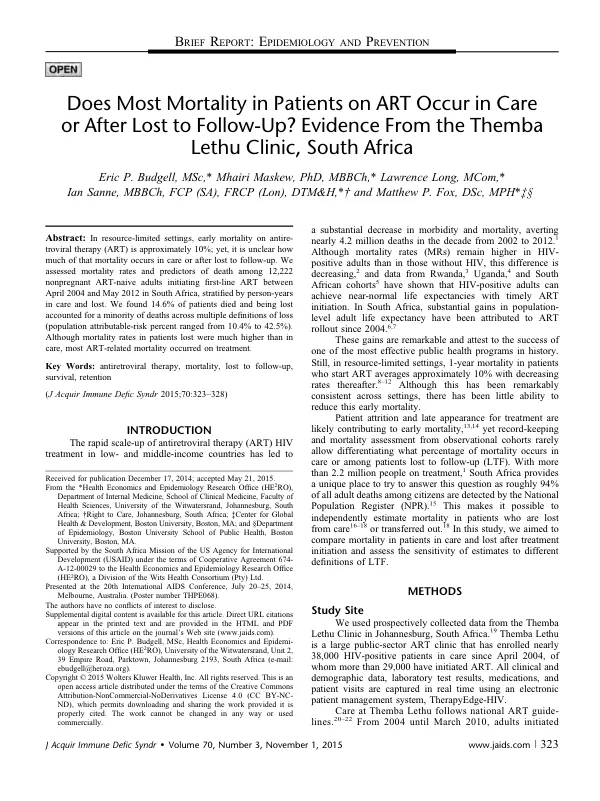
Does Most Mortality in Patients on ART Occur in Care or After Lost to Follow-Up? Evidence From the Themba Lethu Clinic, South Africa
Sign inRIGHT TO CARE
Does Most Mortality in Patients on ART Occur in Care or After Lost to Follow-Up? Evidence From the Themba Lethu Clinic, South Africa
The Themba Lethu Clinic in Johannesburg, South Africa, has been a major site for antiretroviral therapy (ART) treatment since 2004.
2015 · 6 pages
Sign in to readA free account is required to download.
Abstract
The clinic has enrolled nearly 38,000 HIV-positive patients in care, with over 29,000 initiating ART. The clinic's electronic patient management system, TherapyEdge-HIV, captures all clinical and demographic data, laboratory test results, medications, and patient visits in real-time. The study population consisted of 12,222 nonpregnant ART-naive adults initiating first-line ART between April 2004 and May 2012. The exposure variable for the analysis was in-care status, with patients either in care or lost to follow-up (LTF). The primary outcome was mortality, which was ascertained from the National Population Register (NPR). The study found that 14.6% of patients died, with being lost accounting for a minority of deaths across multiple definitions of loss. The mortality rates in patients lost were much higher than in care, but most ART-related mortality occurred on treatment. The study used varying definitions of lost, from $1 day late for a scheduled visit to $6 months late, to assess the sensitivity of estimates. The results showed that the chosen definition of lost can impact results, with population attributable-risk percent ranging from 10.4% to 42.5%. The study used Cox proportional hazards models to estimate the relation between in-care status and all-cause mortality. Predictors of mortality were also estimated after stratifying by in-care status. The hazard ratios were adjusted for baseline covariates, including sex, age, CD4 count, body mass index, hemoglobin level, first-line ART regimen, ART start year, and TB coinfection. The study found that mortality rates in care and lost were 10.4% and 24.5%, respectively, in the first 12 months after ART initiation. The population attributable-risk percent was 21.1%, indicating that 21.1% of all deaths among those lost and in care could be attributed to loss from care. The study's findings suggest that most ART-related mortality occurs on treatment, rather than after patients are lost to follow-up. The Themba Lethu Clinic's data set was linked with the NPR, and the study was approved by the Human Research Ethics Committee of the University of the Witwatersrand. Boston University provided permission for analysis of deidentified data. The study's results have implications for ART treatment programs in resource-limited settings, highlighting the need to improve retention in care and reduce mortality among patients on ART.
Related documents
Documents in this collection
 2018
2018USAID DEC
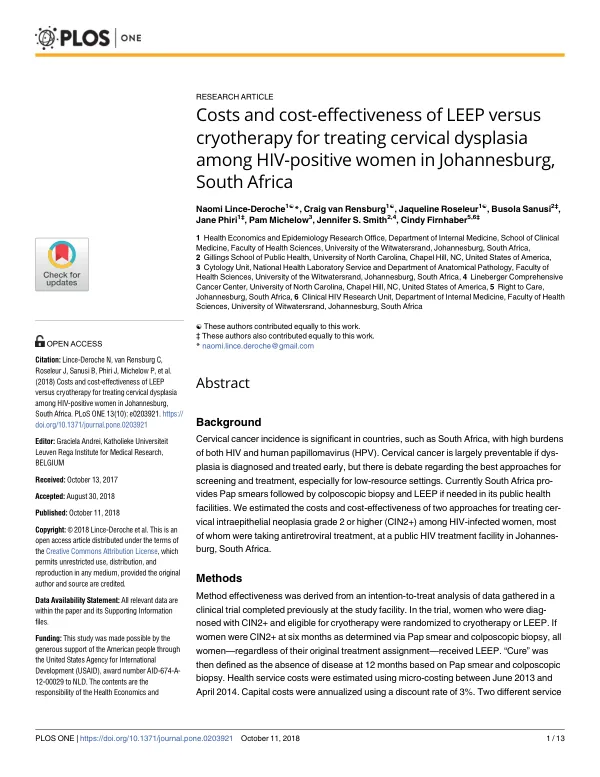
Costs and cost-effectiveness of LEEP versus cryotherapy for treating cervical dysplasia among HIV-positive women in Johannesburg, South Africa
Open record 2021
2021USAID DEC