ABT ASSOCIATES
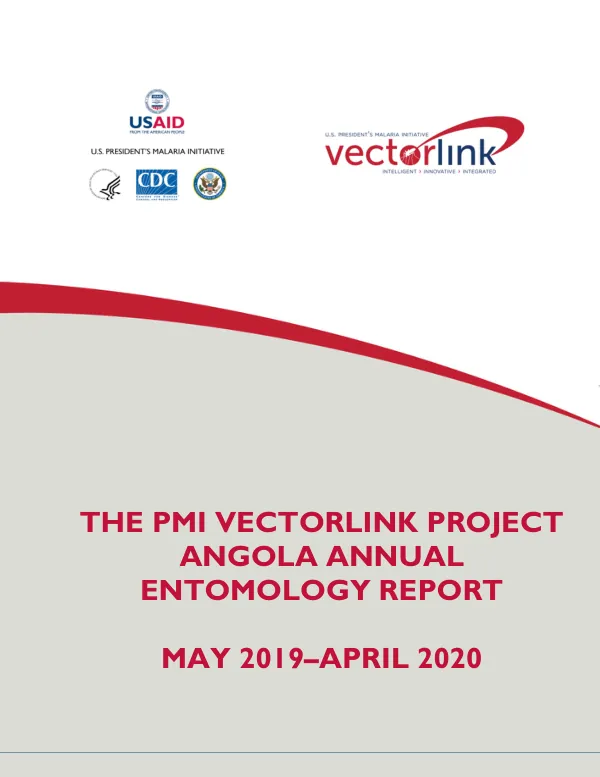
The PMI VectorLink Angola Annual Entomology Report, May 2019–April 2020
Malaria remains a serious public health problem in Angola, with a significant burden on the population.
2020 · 29 pages
Sign in to readA free account is required to download.
Abstract
Vector control strategies, including the distribution of insecticide-treated nets (ITNs) and indoor residual spraying (IRS), have been implemented, but their effectiveness has been irregular. The U.S. President's Malaria Initiative (PMI) Africa Indoor Residual Spraying (AIRS) project conducted longitudinal entomological studies in Angola from 2013 to 2016, collecting data on key entomological parameters. The study focused on three provinces: Huambo, Lunda Sul, and Luanda. In Huambo Province, the primary malaria vector was identified as Anopheles funestus, while in Lunda Sul Province, both Anopheles funestus and Anopheles gambiae were present. The study also found that the density of malaria vectors varied significantly across the provinces, with higher densities observed in Lunda Sul Province. In Huambo Province, the study implemented a comprehensive entomological monitoring program, which included the use of CDC light traps and Prokopack aspirators. The results showed that the primary malaria vector in this province was Anopheles funestus, with a mean density of 0.5 mosquitoes per person per night. In Lunda Sul Province, the study found that both Anopheles funestus and Anopheles gambiae were present, with a mean density of 1.2 mosquitoes per person per night. The study also conducted insecticide susceptibility tests on Anopheles gambiae and Anopheles funestus populations. The results showed that the populations were resistant to pyrethroid insecticides, with a mortality rate of 0% after exposure to permethrin and deltamethrin. However, the populations were susceptible to organophosphate insecticides, with a mortality rate of 100% after exposure to malathion. The study also implemented a comprehensive capacity-building program for local health authorities, which included training on entomological monitoring and vector control strategies. The results showed that the program was effective in improving the capacity of local health authorities to implement vector control strategies. The study concluded that malaria remains a serious public health problem in Angola, with a significant burden on the population. The results of the study highlight the need for a comprehensive vector control strategy that includes the use of ITNs, IRS, and IRS with insecticide susceptibility testing. The study also emphasizes the importance of capacity-building for local health authorities to ensure the effective implementation of vector control strategies. The study implemented a comprehensive entomological monitoring program, which included the