USAID DEC
The Projected Impact of Scaling-Up Midwifery: Estimating Maternal Deaths Prevented by Midwives
Sign inJHPIEGO
The Projected Impact of Scaling-Up Midwifery: Estimating Maternal Deaths Prevented by Midwives
The projected impact of scaling-up midwifery services has been estimated to prevent a significant number of maternal deaths.
2014 · 2 pages
Sign in to readA free account is required to download.
Abstract
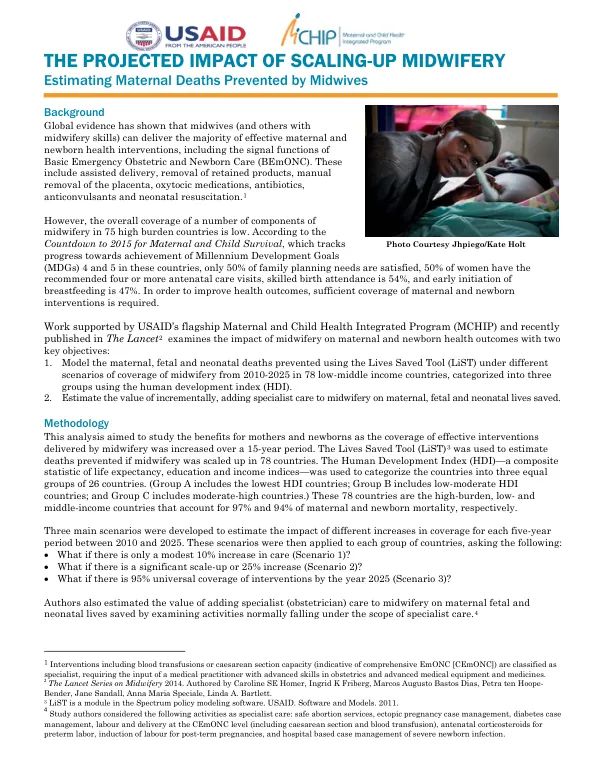
Global evidence has shown that midwives can deliver the majority of effective maternal and newborn health interventions, including assisted delivery, removal of retained products, and neonatal resuscitation. However, the overall coverage of midwifery in 75 high-burden countries is low, with only 54% of skilled birth attendance and 47% of early initiation of breastfeeding. A study supported by USAID's Maternal and Child Health Integrated Program (MCHIP) examined the impact of midwifery on maternal and newborn health outcomes in 78 low-middle income countries. The study used the Lives Saved Tool (LiST) to estimate deaths prevented if midwifery was scaled up in these countries. The countries were categorized into three groups using the Human Development Index (HDI), with Group A including the lowest HDI countries. The study developed three main scenarios to estimate the impact of different increases in coverage for each five-year period between 2010 and 2025. Scenario 1 assumed a modest 10% increase in care, Scenario 2 assumed a significant scale-up of 25% increase, and Scenario 3 assumed 95% universal coverage of interventions by the year 2025. The study found that universal coverage of midwifery maternal and newborn health interventions, excluding family planning, could prevent 61% of maternal, fetal, and neonatal deaths. In the lowest HDI countries, a 10% increase in coverage of midwifery services resulted in a 27% reduction in maternal mortality, while a 25% increase resulted in a 50% reduction, and universal coverage resulted in an 82% reduction. The study also found that family planning alone could prevent 57% of all deaths due to fewer pregnancies in which women would be at risk. In combination, the full package of midwifery care with both family planning and maternal and neonatal health interventions made the most impact, potentially averting a total of 83% of all maternal deaths, stillbirths, and newborn deaths. The study also estimated the value of adding specialist medical care to midwifery on maternal, fetal, and neonatal lives saved. The analysis revealed that the benefit of specialist medical care is most dramatic on maternal mortality, where up to 20% of maternal deaths may be prevented by activities that require comprehensive EmONC. The study concluded that midwifery has the greatest impact when provided within a functional health system with effective referral and transfer mechanisms to specialist care. The study demonstrates the potential to dramatically reduce maternal, fetal, and newborn deaths if sufficient planning and resources are dedicated to scaling up midwifery services. A key finding of this study is that a mere 10% increase in coverage of midwifery services will save lives. The results are supported by a newly published article, co-authored by MCHIP, in the journal PLOS ONE, which revealed that midwifery was almost twice as cost-effective as obstetric care, but a comprehensive strategy increasing midwives, obstetricians, and family planning was the most effective at reducing maternal, newborn, and fetal deaths. The midwife is an effective healthcare worker who can provide the majority of proven maternal and newborn health interventions, and facilitate access to specialist and comprehensive emergency care when necessary to save lives. Given that family planning alone contributes significantly to reducing deaths, efforts must be focused on empowering midwives to increase women's access to family planning. Further research should be done to determine how health systems and community services can be best improved and strengthened in order for midwifery to be available and accessible to all.