USAID DEC
The Return on Investment of Social Inclusion—An Evidence Gap Analysis from Developing Countries
Sign inCARE
The Return on Investment of Social Inclusion—An Evidence Gap Analysis from Developing Countries
The Feed the Future Market Systems and Partnerships (MSP) Activity is advancing learning and good practice in market systems development (MSD) and private sector engagement (PSE) within USAID, USAID partners, and market actors.
2021 · 10 pages
Sign in to readA free account is required to download.
Abstract
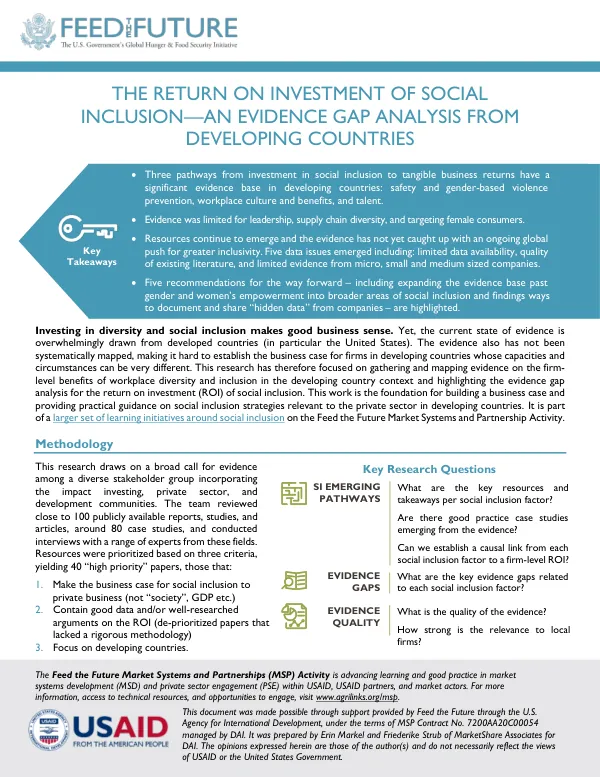
For more information, access to technical resources, and opportunities to engage, visit www.agrilinks.org/msp. Investing in diversity and social inclusion makes good business sense. However, the current state of evidence is overwhelmingly drawn from developed countries, particularly the United States. The evidence also has not been systematically mapped, making it hard to establish the business case for firms in developing countries whose capacities and circumstances can be very different. This research has therefore focused on gathering and mapping evidence on the firm-level benefits of workplace diversity and inclusion in the developing country context and highlighting the evidence gap analysis for the return on investment (ROI) of social inclusion. The research draws on a broad call for evidence among a diverse stakeholder group incorporating the impact investing, private sector, and development communities. The team reviewed close to 100 publicly available reports, studies, and articles, around 80 case studies, and conducted interviews with a range of experts from these fields. Resources were prioritized based on three criteria, yielding 40 "high priority" papers, those that make the business case for social inclusion to private business, contain good data and/or well-researched arguments on the ROI, and focus on developing countries. Three pathways leading from investments in social inclusion to tangible business returns have a significant evidence base in developing countries: safety and gender-based violence prevention, workplace culture and benefits, and talent. Workplace safety and GBV prevention emerged as a priority area that directly links to productivity. A significant body of research has established a direct link between physical security, safe work environments, and protection from harassment with workers' productivity, motivation, and focus at work, leading to higher outputs, fewer errors, and greater profits. Evidence from various studies highlights the impact of workplace safety and GBV prevention on productivity. For example, research in Papua New Guinea calculated an 11-day/year cost per worker due to dealing with violence, translating into 2-9 percent of the total salary bill in direct cost and up to 45 percent in indirect cost. A survey of 39 organizations in Myanmar estimated a productivity loss of 14 percent due to presenteeism. Better Work evidence from Haiti, Jordan, Vietnam, and Nicaragua also highlights how the prevalence of sexual harassment in factories leads to low production efficiency, increased workforce turnover, and reduced profits. Workplace safety and GBV prevention also mitigate reputational and compliance risk, with tangible effects on business-to-business relationships. Companies that comply with safety standards decrease annual audits from their buyers by 19 percent to 43 percent and increase their ability to retain buyers by up to 56 percent. This may lead to higher-value buyers and establish long-term "preferred supplier" relationships. The research also highlights the importance of workplace culture and benefits in driving business returns. A study by the International Labor Organization (ILO) found that companies with a positive workplace culture experience higher productivity, lower turnover, and improved employee well-being. Similarly, a study by the World Bank found that companies that offer benefits such as health insurance and retirement plans experience higher employee retention and productivity. Finally, the research highlights the importance of talent in driving business returns. A study by McKinsey found that companies that invest in talent development experience higher productivity, innovation, and competitiveness. Similarly, a study by the World Economic Forum found that companies that prioritize talent development experience higher employee engagement and retention. Overall, the research highlights the importance of social inclusion in driving business returns in developing countries. By investing in workplace safety and GBV prevention, workplace culture and benefits, and talent, companies can experience higher productivity, lower turnover, and improved employee well-being, leading to greater profits and competitiveness.