USAID DEC
The Rewards of an Improved Enabling Environment: How Input Market Reform Helped Kenyan Farmers Raise Their Fertilizer Use by 36%
Sign inMICHIGAN STATE UNIVERSITY FOUNDATION
The Rewards of an Improved Enabling Environment: How Input Market Reform Helped Kenyan Farmers Raise Their Fertilizer Use by 36%
Agricultural productivity remains a major challenge in developing countries, particularly in Sub-Saharan Africa, where fertilizer use lags far behind the rest of the world.
2016 · 4 pages
Sign in to readA free account is required to download.
Abstract
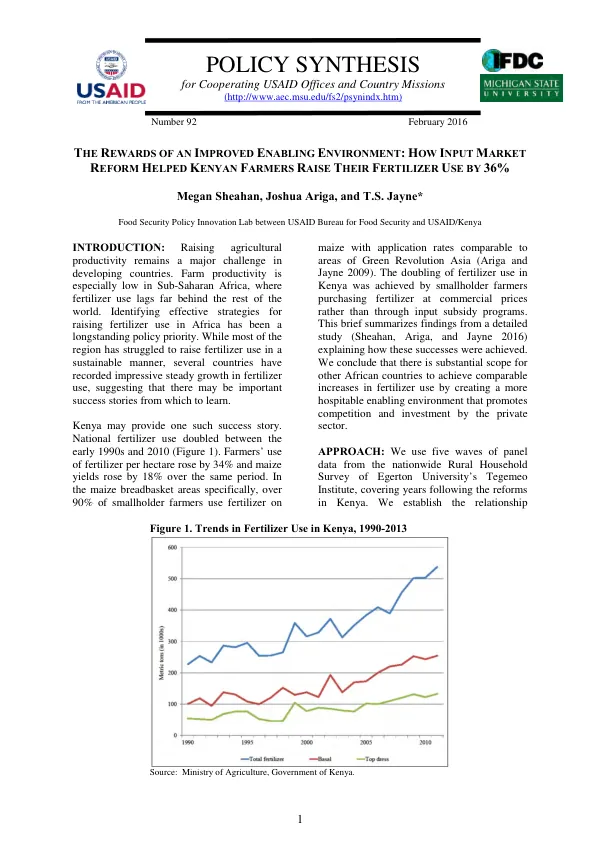
Identifying effective strategies for raising fertilizer use in Africa has been a longstanding policy priority. Kenya may provide one such success story, having doubled its fertilizer use between the early 1990s and 2010, with farmers' use of fertilizer per hectare rising by 34% and maize yields increasing by 18% over the same period. The doubling of fertilizer use in Kenya was achieved by smallholder farmers purchasing fertilizer at commercial prices rather than through input subsidy programs. This brief summarizes findings from a detailed study explaining how these successes were achieved. The study used five waves of panel data from the nationwide Rural Household Survey of Egerton University's Tegemeo Institute, covering years following the reforms in Kenya. The study established the relationship between input marketing policy reforms, changes in retail fertilizer price levels attributable to these reforms, and changes in the distance traveled by farmers to obtain fertilizer associated with rapid new investment by fertilizer retailers in rural areas. Prior to reform, fertilizer markets in Kenya were controlled by state or quasi-state agencies that set prices at state-run retail locations, established maximum selling prices for private retailers, and controlled which firms could receive licenses. The reform process was initiated after growing realization that rent-seeking behavior was negatively affecting farmers' access to fertilizer and that maximum fixed selling prices were hindering private retailers from distributing fertilizer in remote rural areas. Consequently, many farmers needed to travel long distances to access fertilizer, and these transaction costs impeded demand. In response to these concerns, the Government of Kenya eliminated import quotas, controls on fertilizer prices, and preferential access to foreign exchange in the early 1990s. Following the reforms, fertilizer supply channels evolved to accommodate new private sector entry, and the distribution of commercial fertilizer to farmers throughout the country increased significantly. After the elimination of fixed maximum selling prices, private firms invested heavily in their fertilizer supply chains and new firms entered the market, which ultimately improved competition. The main outcomes of these reforms were a decline in fertilizer marketing margins between the Port of Mombasa and upland retail markets, and an expansion in the number of rural retailers carrying fertilizer in their stores. Both of these changes reduced the costs that farmers incurred in obtaining fertilizer. Declining marketing margins were attributed to increased competition in local distribution, the attraction of international companies to partner with local importers, new investment by companies in more efficient fertilizer supply chain operations, and private companies expanding into regional fertilizer distribution. The domestic diammonium phosphate (DAP) fertilizer marketing margin declined by 45% over the period 1997 to 2010, which was almost totally passed along to farmers in the form of lower fertilizer prices. This decline is consistent with Government of Kenya reported trends in up-country wholesale prices. Our analysis finds that 60% of the variation in DAP prices paid by Kenyan farmers over the period 1997 to 2010 is explained by changes in domestic marketing margins between Mombasa and the farmers' point of purchase. The number of rural fertilizer retailers increased dramatically after the reforms were initiated, with the estimated number of rural fertilizer retailers in Kenya rising from 5,000 in 1996 to 8,000 by 2000. Fertilizer retailers moved further into rural areas and became more accessible to smallholders, leading to lower 'last mile' costs for farmers moving fertilizer from retail shops to their farms. The nationwide farm survey data shows a substantial decline in the distance traveled by farmers to the nearest retail fertilizer seller over this period. Based on the estimated changes in nitrogen prices and distances traveled by farmers to purchase fertilizer that are attributable to Kenya's input market reforms, we then estimated the effect of these changes on smallholder fertilizer use and maize production. Our estimation results show that between 1997 and 2010, the observed fall in real nitrogen prices attributable to the reforms led to a 36% increase in nitrogen use on smallholder maize fields. This increase in fertilizer use attributable to input market reforms is estimated to have resulted in a 9% increase in national maize production, which is comprised of both a productivity effect (intensification) and area planted to maize effect (extensification).


![NAPAS:Malawi Annual Work Plan [FY2016]](https://covers.devme.ai/gen/145459.webp)