USAID DEC
Seed and Fertilizer Policy in Africa: Recommendations to the African Union Commission
Sign inUSAID DEC
Seed and Fertilizer Policy in Africa: Recommendations to the African Union Commission
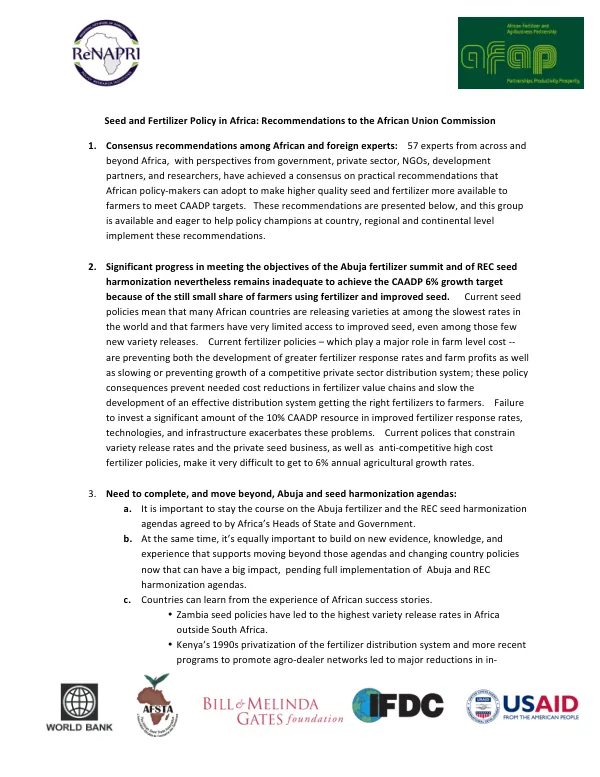
The African Union Commission has received recommendations from a group of 57 experts from across and beyond Africa, representing government, private sector, NGOs, development partners, and researchers.
12 pages
Sign in to readA free account is required to download.
Abstract
These experts have achieved a consensus on practical recommendations that African policymakers can adopt to make higher quality seed and fertilizer more available to farmers to meet CAADP targets. The current seed policies in many African countries are releasing varieties at among the slowest rates in the world, and farmers have very limited access to improved seed, even among those few new variety releases. Current fertilizer policies, which play a major role in farm-level costs, are preventing both the development of greater fertilizer response rates and farm profits, as well as slowing or preventing growth of a competitive private sector distribution system. Significant progress has been made in meeting the objectives of the Abuja fertilizer summit and of REC seed harmonization, but this progress remains inadequate to achieve the CAADP 6% growth target due to the still small share of farmers using fertilizer and improved seed. Failure to invest a significant amount of the 10% CAADP resource in improved fertilizer response rates, technologies, and infrastructure exacerbates these problems. Countries can learn from the experience of African success stories, such as Zambia's seed policies, which have led to the highest variety release rates in Africa outside of South Africa, and Kenya's privatization of the fertilizer distribution system, which led to major reductions in in-country fertilizer cost and cut in half the distance farmers had to go to purchase inputs. Ghana's fertilizer voucher system created opportunities for many agro-dealers rather than shutting down competition by working only with a privileged few companies. Guiding principles for seed and fertilizer sector policy include the private sector's ability to lower costs and deliver quality seed and fertilizer, but only if government creates an enabling environment and a "level playing field." A level playing field means preventing subsidized state enterprises from competing with the private sector and avoiding the practice of selecting a few privileged companies for government to work with. African governments can take key practical unilateral seed policy actions now to speed the rate of variety release and expand seed production to meet farmer needs and demand. These recommended actions are based on the widespread observation, backed by significant research, that African farmers have access to too few new varieties and high-quality seeds each year to support rapid yield growth, and seed companies have a difficult, often impossible, task getting government approval to introduce new varieties.