USAID
The Role of Public Administration in Developing Countries
The role of public administration in developing countries is a critical issue that requires careful consideration.
2012 · 12 pages
Sign in to readA free account is required to download.
Abstract
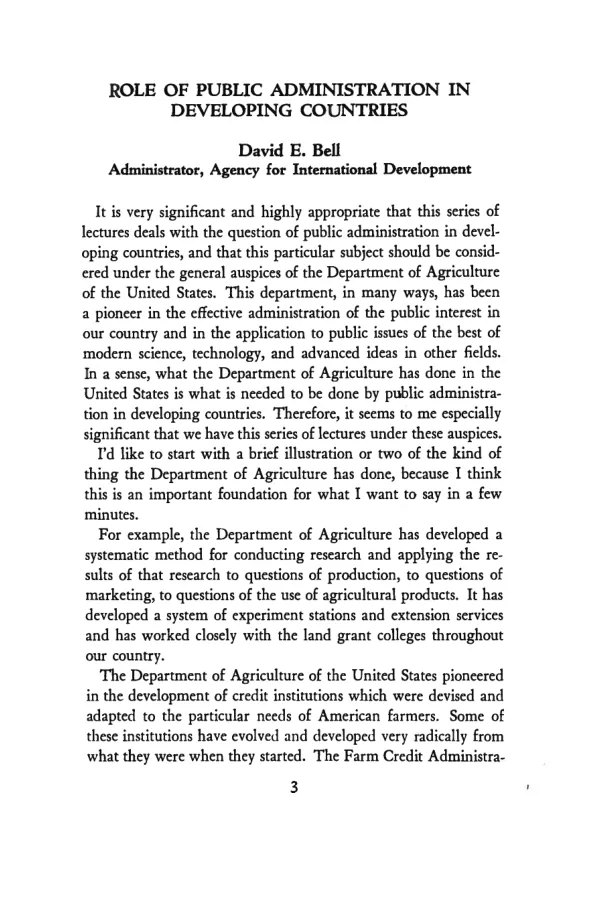
The Department of Agriculture in the United States has been a pioneer in effective administration of the public interest, applying modern science, technology, and advanced ideas to public issues. The Department's systematic method for conducting research and applying its results to production, marketing, and use of agricultural products has been particularly effective. This approach has led to the development of credit institutions, crop forecasting services, and other initiatives that have contributed to the country's productive agricultural system. The Department's efforts have been guided by a deep belief in local self-reliance, individual initiative, and enterprise, as well as a commitment to limiting the Federal Government's efforts to what can only be done through the national government. This approach has resulted in a system that is pragmatic, probing, experimental, and designed to meet real problems in the public interest. The Department's work has been remarkably non-ideological, with a mix of public and private activity that has evolved over time. The Department's experience has a direct bearing on the question of public administration in developing societies. When visiting and working in underdeveloped countries, it is natural to think that the kind of services provided by the Department of Agriculture are needed. Research services, educational and extension services, better supply systems, and marketing advice are all essential for improving agricultural productivity and income. However, it is a mistake to conclude that developing countries need to duplicate the institutions that exist in the United States. The experience of the United States in trying to help underdeveloped countries improve their public administration has been mixed. The basic methods used have been to bring large numbers of persons from underdeveloped countries to the United States for training and to establish schools, institutions, and departments of public administration in local colleges and universities or separate agencies. While this approach has had some success, it also carries certain risks, such as teaching people how to solve problems in the United States rather than their own countries. The development of effective systems and institutions in underdeveloped countries requires a deep understanding of their background, environment, capabilities, and problems. Institutions that grow out of their background and fit their environment and capabilities are more likely to be successful than those that are transplanted from advanced countries. This approach requires a commitment to learning from the experiences of developing countries and adapting solutions to their unique needs and circumstances. In conclusion, the role of public administration in developing countries is a complex issue that requires careful consideration. While the experience of the United States has been valuable, it is essential to avoid the mistake of trying to duplicate institutions from advanced countries. Instead, developing countries should be encouraged to develop their own effective systems and institutions that grow out of their background and fit their environment and capabilities.