USAID DEC
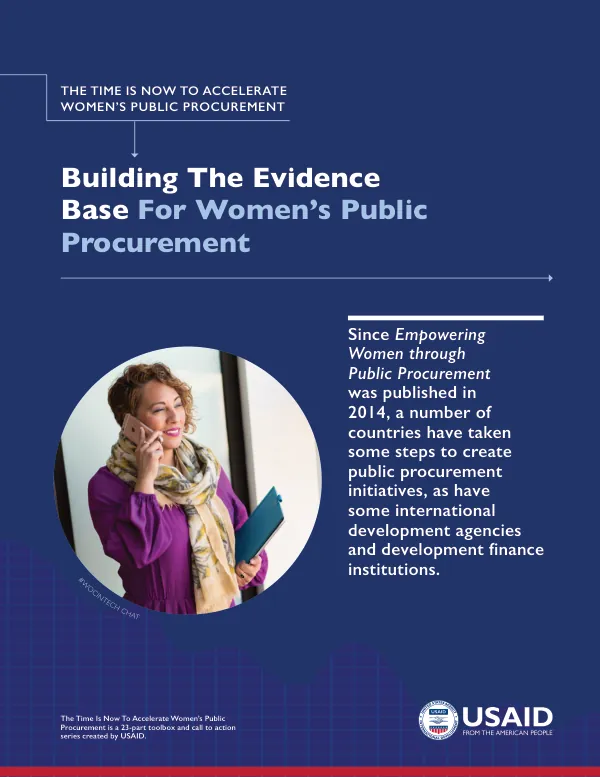
The Time Is Now to Accelerate Women’s Public Procurement : Building the Evidence Base for Women’s Public Procurement
Sign inUSAID
The Time Is Now to Accelerate Women’s Public Procurement : Building the Evidence Base for Women’s Public Procurement
The establishment of public procurement initiatives for women-owned businesses has been a gradual process, with significant milestones achieved over the past several decades.
2021 · 10 pages
Sign in to readA free account is required to download.
Abstract
The Minority Business Enterprise (MBE) Program in the United States was established in 1970, requiring firms to be certified as 51 percent owned, managed, and controlled by one or more ethnic minorities to access preferential federal contracting opportunities. In the 1990s, a similar definition was adopted for certified women-owned businesses, with the Women's Business Enterprise (WBE) Program established in the United States. This program used the same 51 percent criteria as the MBE Program but for women's corporate procurement. The term Women-Owned Small Business (WOSB) was created in December 2000 for the purpose of public procurement. The WEConnect International organization, founded in 2009, has played a significant role in internationalizing the U.S. model of supplier diversity initiatives for women-owned businesses. WEConnect has promoted the concept of supplier diversity, the role of certification, and the globalization of the 51 percent definition required for certification. The organization has influenced public procurement in numerous countries and has been involved in several UN and World Bank Group initiatives. The International Trade Centre (ITC), a joint agency of the UN and the World Trade Organization, launched its Women and Trade program in 2010. The program initially focused on corporate procurement and international trade but later shifted its focus to public procurement. In 2014, the ITC published its first comprehensive female-oriented public procurement publication, Empowering Women through Public Procurement, by Keric Chin. The publication provided a methodology and helped catalyze progress in many countries, including initiatives funded by national donor agencies. The ITC's Women and Trade program has continued to play a significant role in promoting women's public procurement, with the organization working closely with WEConnect International and other stakeholders to advance the cause. The W20, a group of women leaders from the G20 countries, has also been actively involved in promoting women's public procurement. The W20 has called for national year-on-year goals regarding procurement, international trade, and ecommerce, as well as a target of a minimum 10 percent increase in public procurement by 2030. The W20 has also established a Showcase of Best Practices, a Peer Learning Network, and Action Alliances and advocacy initiatives focused on public procurement and other priority issues. The International Standards Organization has also been working to develop definitions and guidelines for women-owned businesses, with the goal of facilitating international trade and commerce. The organization has published a number of publications and guidelines on the topic, including a how-to manual on making public procurement work for women. Overall, the establishment of public procurement initiatives for women-owned businesses has been a gradual process, with significant milestones achieved over the past several decades. The work of organizations such as WEConnect International, the ITC, and the W20 has helped to promote women's public procurement and advance the cause of women's economic empowerment.