USAID DEC
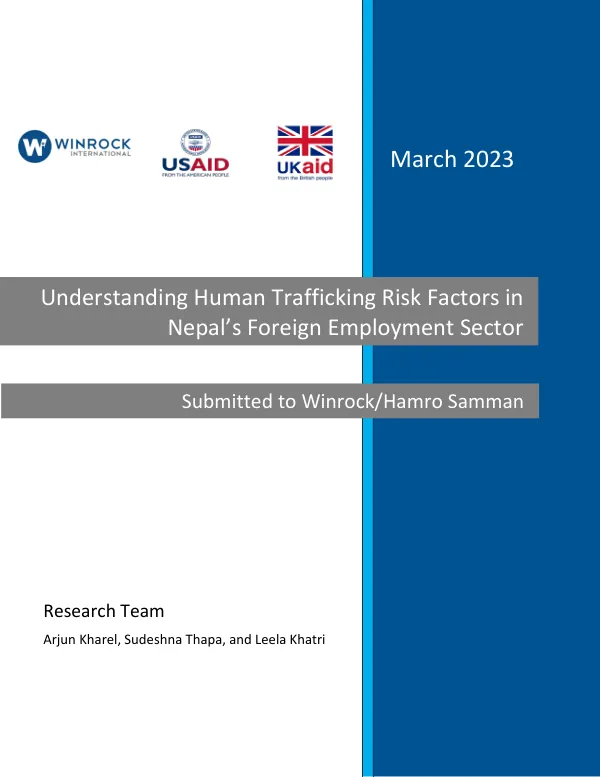
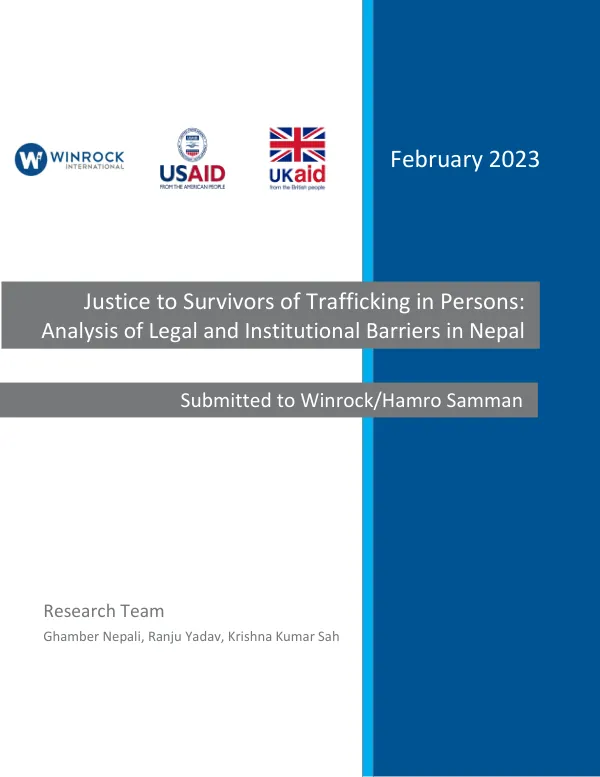
Justice to Survivors of Trafficking in Persons: Analysis of Legal and Institutional Barriers in Nepal
Sign inINTERNATIONAL ORGANIZATION FOR MIGRATION
Justice to Survivors of Trafficking in Persons: Analysis of Legal and Institutional Barriers in Nepal
The research project, "Justice to Survivors of Trafficking in Persons: Analysis of Legal and Institutional Barriers in Nepal," was conducted under the John D.
2023 · 43 pages
Sign in to readA free account is required to download.
Abstract
Rockefeller 3rd Scholars Program in partnership with the Hamro Samman Project and funded by the United States Agency for International Development (USAID) and the United Kingdom's UK Aid. The study aimed to identify the legal and institutional barriers for survivors of trafficking in persons (TIP) to access justice in Nepal. The research was conducted in three districts: Sindhupalchowk, Makawanpur, and Parsa, with a total of 30 in-depth interviews with TIP survivors and 27 key informant interviews with government representatives, judiciaries, legal experts, and civil society organizations. The study found that the Human Trafficking and Transportation (Control) Act (HTTCA) of 2007 was a specific law written to control and manage trafficking crimes, but it had limitations in the investigation process and in covering different forms of trafficking issues, such as forced labor. The study also found that more than 35 percent of TIP survivors do not enter into the legal process, and among the filed cases, only a small proportion are prosecuted and settled. Among the cases that have been decided, only a minimal number of victims have received compensation. The research identified the legal and institutional barriers for TIP survivors to access justice and put forth recommendations to improve the legal and institutional systems in Nepal. The study's findings highlighted the need for a centralized and updated database on human trafficking in Nepal. The existing evidence has shown a strong link between human trafficking and labor migration. The study also found that the majority of trafficking victims were Janjati and Dalits, and that the existing laws and policies have been ineffective in addressing the issues of human trafficking. The research used a qualitative study design, which involved in-depth interviews with TIP survivors and key informant interviews with government representatives, judiciaries, legal experts, and civil society organizations. The study was conducted in consultation with the John D. Rockefeller 3rd Scholars Program, the JDR3 research advisory committee, and the Hamro Samman project team, along with the approval of the National Human Rights Commission (NHRC). The study's recommendations included improving the investigation process, expanding the scope of the HTTCA to cover different forms of trafficking issues, and increasing compensation for victims. The study also recommended strengthening the institutional arrangements for providing services to TIP survivors and improving the access to justice for survivors. The study's findings and recommendations aim to contribute to the improvement of the legal and institutional systems in Nepal to address the issues of human trafficking and provide justice to survivors.
Related documents