BANYAN GLOBAL
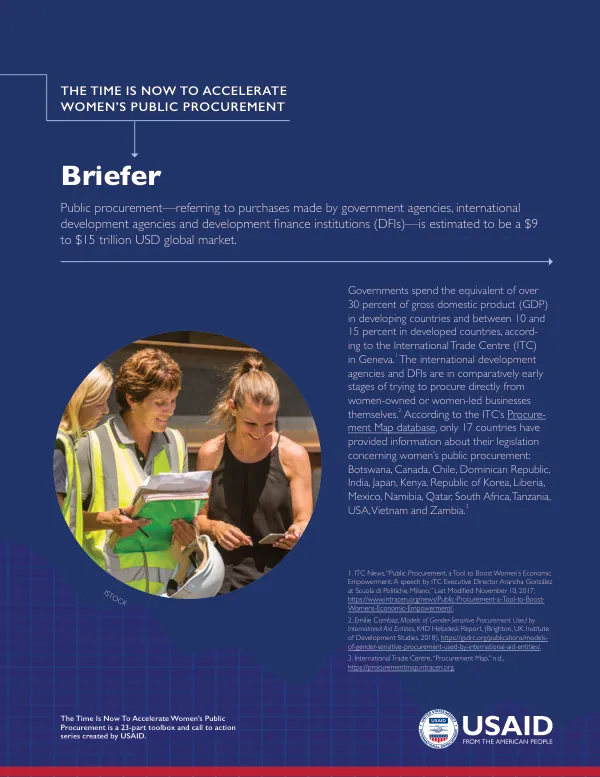
The Time is Now to Accelerate Women's Public Procurement: Briefer
Governments spend a significant portion of their gross domestic product (GDP) on public procurement, with developing countries allocating over 30 percent and developed countries allocating between 10 and 15 percent.
2021 · 4 pages
Sign in to readA free account is required to download.
Abstract
According to the International Trade Centre (ITC) in Geneva, public procurement is a substantial market, estimated to be worth between $9 and $15 trillion USD globally. Public procurement policies have the potential to promote inclusive growth and gender equality, and to reduce poverty. However, women-owned businesses have historically received less than 1 percent of public procurement contracts, despite women owning an estimated 38 percent of all small and medium enterprises (SMEs) globally. The lack of gender-disaggregated data and clear definitions, legal and regulatory hurdles, sociocultural norms and gender biases, limited access to business networks and finance, and a lack of business and technical training have constrained women's progress in public procurement. The ITC's Procurement Map database indicates that only 17 countries have provided information about their legislation concerning women's public procurement. These countries include Botswana, Canada, Chile, Dominican Republic, India, Japan, Kenya, Republic of Korea, Liberia, Mexico, Namibia, Qatar, South Africa, Tanzania, USA, Vietnam, and Zambia. The Time Is Now To Accelerate Women's Public Procurement is a 23-part toolbox and call to action series created by USAID. The series aims to accelerate women's access to public procurement in an efficient, effective, and highly strategic manner. The effort involves mapping the global landscape for women's public procurement, removing barriers, and revitalizing women's enterprises after the COVID-19 pandemic. The toolbox is designed to provide case studies and "snapshots" that showcase good and best practices and lessons learned about how different models help to overcome specific barriers and challenges. It also provides recommendations on how to strengthen the ecosystem for women's public procurement and calls for virtual knowledge-sharing and coalition-building to fast-track women's expanded participation in public procurement. The toolbox builds on the success of four excellent women's policy fora, conducted virtually in 2020 in the midst of the COVID-19 pandemic. These policy fora used expert facilitation and a suite of virtual technologies to greatly accelerate international consensus development. The toolbox aims to promote participation in a Virtual International Summit on Women and Public Procurement to be held in the fourth quarter of 2021, co-hosted by the International Trade Centre and the Women20 (W20) of the G20 countries. The summit will bring together key international institutions, countries, and stakeholders to develop a powerful coalition that will accelerate women's access to public procurement. Participants will develop strategies, evaluate and endorse model templates, laws, and policies, identify good and best practices, share knowledge, and develop partnerships, programs, and online curricula to build government and entrepreneurial capacity for strengthening women's procurement capabilities and national competitiveness through public procurement for women.
Related documents