DELOITTE CONSULTING, LLP
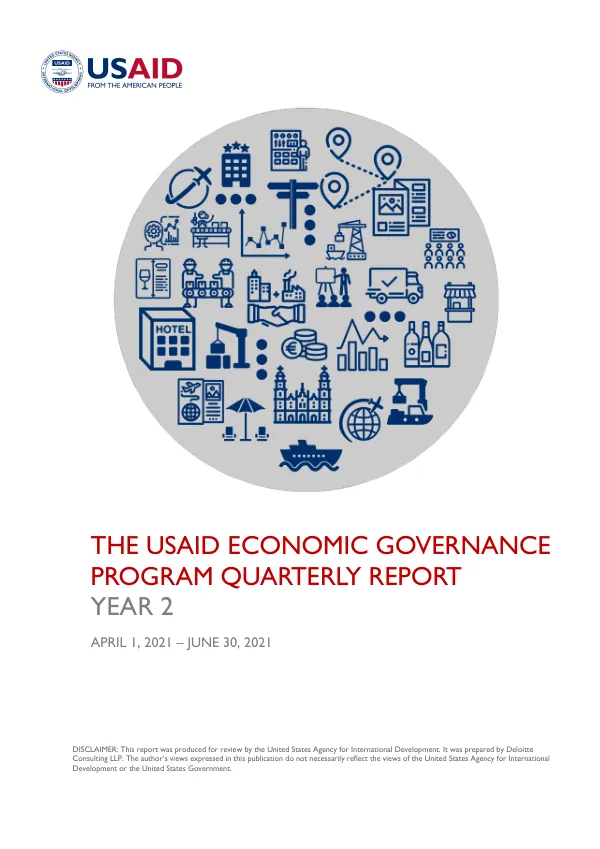
The USAID Economic Governance Program Quarterly Report, Quarter 3, Year 2
The USAID Economic Governance Program is a five-year project designed to improve economic governance and leadership in Georgia.
2021 · 66 pages
Sign in to readA free account is required to download.
Abstract
The program aims to support the development of a system to enforce consistent and cost-effective economic policies, laws, and regulations (PLRs). Good economic governance is defined as a system for developing, implementing, and enforcing economic PLRs that are predictable, consistent, transparent, inclusive, and cost-effective. The program focuses on strengthening the government of Georgia to lead the development, implementation, and enforcement of PLRs. This is achieved through various components, including capital market reform, tax dispute resolution reform, insolvency reform, state procurement reform, trade policy reform, water resource management reform, and regulatory impact assessment reform. The program also supports the development of private sector associations and civil society organizations to affect the development, implementation, and enforcement of PLRs. One of the key areas of focus is the capacity building of civil society organizations and public sector associations. This includes the development of a reformeter, a public-private dialogue quality tracking system, coalition building, public-private dialogue platforms, and a regulatory impact assessment peer review platform. The program also supports ongoing and future USAID/Georgia economic growth activities in analysis and drafting of policy, laws, and regulations. The program has made significant progress in various areas, including public-private dialogue successes and lessons learned, gender equality and women's economic empowerment, youth participation in the policy reform process, private sector partnership in the policy reform process, environmental impact of policy reforms, donor coordination, grants, small business utilization, knowledge management, public information, and outreach. In the capital market reform area, the program has supported the development of a new capital market law and the establishment of a capital market commission. The tax dispute resolution reform area has seen the development of a new tax dispute resolution law and the establishment of a tax dispute resolution commission. The insolvency reform area has focused on the development of a new insolvency law and the establishment of an insolvency commission. The state procurement reform area has supported the development of a new state procurement law and the establishment of a state procurement commission. The trade policy reform area has focused on the development of a new trade policy law and the establishment of a trade policy commission. The water resource management reform area has supported the development of a new water resource management law and the establishment of a water resource management commission. The regulatory impact assessment reform area has focused on the development of a new regulatory impact assessment law and the establishment of a regulatory impact assessment commission. The program has also supported the development of private sector associations and civil society organizations to affect the development, implementation, and enforcement of PLRs. The program has achieved significant results in various areas, including a 27% increase in the number of businesses that have benefited from public-private dialogue, a 25% increase in the number of women who have benefited from economic empowerment programs, and a 20% increase in the number of youth who have participated in the policy reform process. The program has also supported the development of a knowledge management system, which has facilitated the sharing of knowledge and best practices among stakeholders. The program has also established a public information and outreach system, which has facilitated the dissemination of information to stakeholders. The program has also supported the development of a small business utilization system, which has facilitated the utilization of small businesses in the policy reform process. The program has also established a grants system, which has facilitated the provision of grants to stakeholders. The program has also supported the development of a donor coordination system, which has facilitated the coordination of efforts among donors. The program has also established an environmental impact assessment system, which has facilitated the assessment of the environmental impact of policy reforms. The program has also supported the development of a private sector partnership system, which has facilitated the partnership between the private sector and the government in the policy reform process. The program has also established a gender equality and women's economic empowerment system, which has facilitated the empowerment of women in the economy. The program has also supported the development of a youth participation system, which has facilitated the participation of youth in the policy reform process. The program has also established a knowledge management system, which has facilitated the sharing of knowledge and best practices among stakeholders. The program has also supported the development of a public information and outreach system, which has facilitated the dissemination of information to stakeholders. The program has also established a small business utilization system, which has facilitated the utilization of small businesses in the policy reform process. The program has also supported the development of a grants system, which has facilitated the provision of grants to stakeholders. The program has also established a donor coordination system, which has facilitated the coordination of efforts among donors. The program has also supported the development of an environmental impact assessment system, which has facilitated the assessment of the environmental impact of policy reforms. The program has also established a private sector partnership system, which has facilitated the partnership between the private sector and the government in the policy reform process. The program has also supported the development of a gender equality and women's economic empowerment system, which has facilitated the empowerment of women in the economy. The program
Related documents