USAID DEC
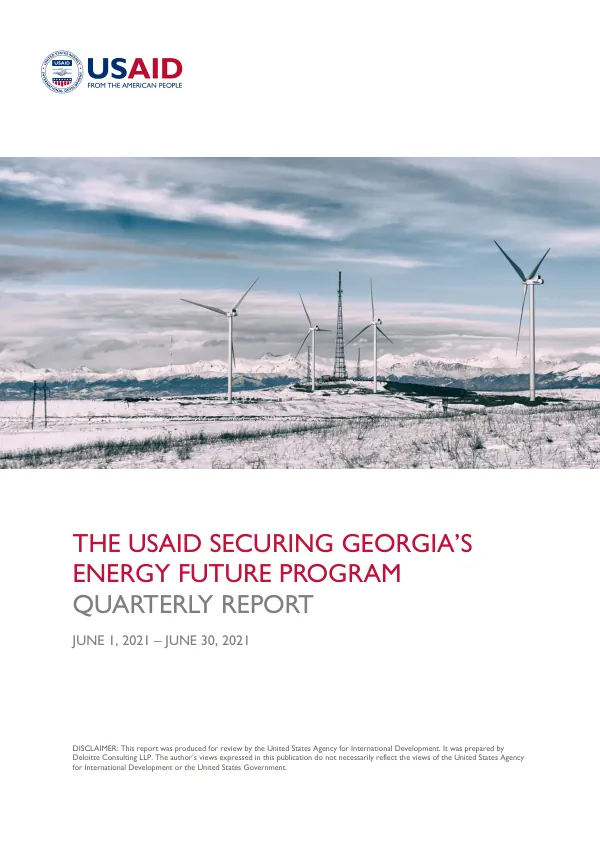
USAID Securing Georgia’s Energy Future Program Quarterly Report June 1, 2021 – June 30, 2021
Sign inDELOITTE CONSULTING, LLP
USAID Securing Georgia’s Energy Future Program Quarterly Report June 1, 2021 – June 30, 2021
The USAID Securing Georgia's Energy Future Program aims to improve Georgia's energy security and reduce its susceptibility to malign influence.
2021 · 17 pages
Sign in to readA free account is required to download.
Abstract
The program's objective is to achieve sound long-term policymaking and governance, increase private-sector investment in indigenous renewable energy production, build the capacity of Georgian institutions to effectively manage domestic energy markets, and improve energy sector resilience to cyber threats. The program will support the development of Georgia's energy sector into an open, regionally-integrated, market-driven system, capable of independently planning, financing, and implementing solutions to Georgia's energy security challenges. The specific program objectives are: Improved Energy System Planning, Increased Investment to Promote Energy Sector Resilience, Improved Governance and Operations of Well-Functioning Georgian Energy Market, and Reduced Cybersecurity Vulnerabilities. The program's first quarter report documents the ongoing activities and progress made by the USAID Securing Georgia's Energy Future Program for the period June 1, 2021 to June 30, 2021. Due to COVID-19 restrictions, the available staff were adjusted to full online work for the finalization of the Year-1 Plan. The program took a collaborative approach to work planning with strong counterpart and USAID engagement in validating and developing activities. The program hosted its first in-person meeting on June 21st, featuring welcome remarks from Marika Olson, USAID/Georgia Economic Growth Office Director. Olson expressed confidence in the success of the program, emphasizing the importance of sound energy infrastructure for the energy sector and adjacent sectors contributing to economic development. She also highlighted the program's focus on private sector engagement, diversifying energy resources, and modernizing energy infrastructure. The program's quarterly report details the progress in each task in reference to corresponding areas of the Program's Year 1 Preliminary Work Plan. The report outlines the program's activities, including Improved Energy System Planning, Increased Investment to Promote Energy Sector Resilience, Improved Governance and Operations of Well-Functioning Georgian Energy Market, and Reduced Cybersecurity Vulnerabilities. The program's approach to work planning involves a collaborative approach with strong counterpart and USAID engagement in validating and developing activities. The program also reshaped its focus on private sector engagement, with regular consultations, meetings, and discussions to identify avenues for improvement that will drive sustained impact. The program intends to continuously reinforce elements of Collaborating, Learning & Adapting (CLA) and Knowledge Management (KM) to adjust, assess, capture, and disseminate critical information to improve activity management loops, decision gates, and stakeholder benefits. The program's quarterly report highlights the progress made in the first quarter, including the hosting of the first in-person meeting, the finalization of the Year-1 Plan, and the ongoing activities in each task area. The report provides an overview of the program's activities, progress, and achievements in the first quarter of the program.