USAID DEC
The Value of the Lake Nabugabo Wetland System Ramsar Site Planning for Resilience in East Africa through Policy, Adaptation, Research and Economic Development (PREPARED) Project
Sign inUSAID
The Value of the Lake Nabugabo Wetland System Ramsar Site Planning for Resilience in East Africa through Policy, Adaptation, Research and Economic Development (PREPARED) Project
The Lake Nabugabo wetland complex was designated as a Ramsar Site in 2004, covering an area of 22,000 hectares.
2018 · 4 pages
Sign in to readA free account is required to download.
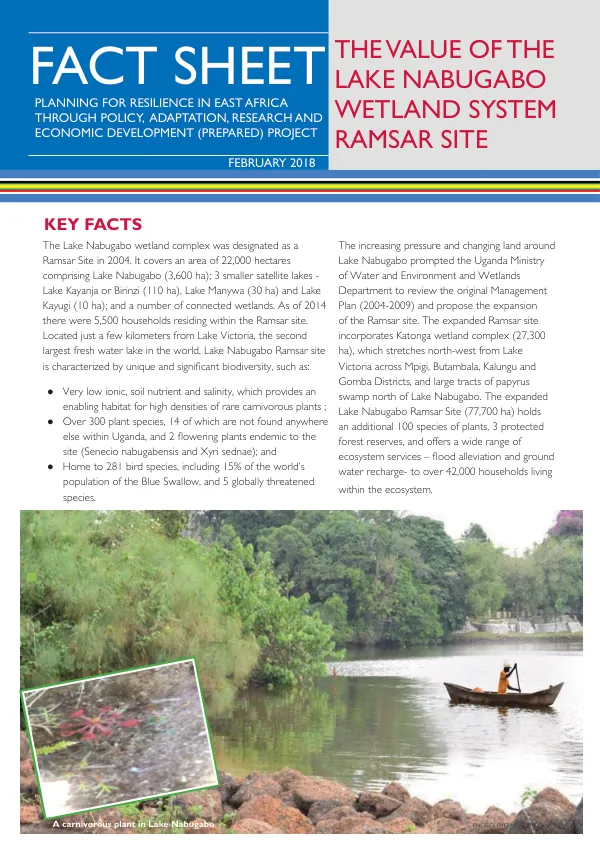
Abstract
The site comprises Lake Nabugabo, three smaller satellite lakes, and a number of connected wetlands. As of 2014, there were 5,500 households residing within the Ramsar site. Located near Lake Victoria, the second-largest freshwater lake in the world, Lake Nabugabo Ramsar site is characterized by unique and significant biodiversity. The site's unique features include very low ionic, soil nutrient, and salinity levels, which provide an enabling habitat for high densities of rare carnivorous plants. The site is home to over 300 plant species, 14 of which are not found anywhere else within Uganda, and 2 flowering plants endemic to the site. Additionally, the site supports 281 bird species, including 15% of the world's population of the Blue Swallow, and 5 globally threatened species. The increasing pressure and changing land use around Lake Nabugabo prompted the Uganda Ministry of Water and Environment and Wetlands Department to review the original Management Plan (2004-2009) and propose the expansion of the Ramsar site. The expanded Ramsar site incorporates the Katonga wetland complex, which stretches north-west from Lake Victoria across Mpigi, Butambala, Kalungu, and Gomba Districts, and large tracts of papyrus swamp north of Lake Nabugabo. The expanded Lake Nabugabo Ramsar Site (77,700 ha) holds an additional 100 species of plants, 3 protected forest reserves, and offers a wide range of ecosystem services, including flood alleviation and groundwater recharge, to over 42,000 households living within the ecosystem. An economic valuation of ecosystem services of the Lake Nabugabo wetland complex was completed in 2014 by the USAID-funded Planning for Resilience in East Africa through Policy, Adaptation, Research, and Economic Development (PREPARED) Project. The estimated value of ecosystem services provided by the original Nabugabo Ramsar Site is USD $4,558,000 a year, which is an average of USD $333 per ha of wetland habitat per year. An extended Ramsar site would increase and secure economic value of the wetland to more than USD $44,010,000 million (90% increase) or USD $566 per ha per year. The assessment valued a total of 11 ecosystem services, which fell into three major categories: provisioning, regulating and supporting, and cultural services. The values of the services valued are summarized below. The original Ramsar site provides provisioning services worth USD $200,000 for capture fishery, USD $540,000 for wood-based energy and timber, and USD $820,000 for non-wood/non-fish wetland products. The regulating and supporting services include soil fertility and moisture, pollination, seed dispersal, and pest control, water storage and recharge, regulation of water quality, and flood attenuation. The cultural services include nature-based tourism, valued at USD $800,000. The rapid economic assessment makes it clear that Nabugabo's wetland species and habitats make a substantial contribution to local, national, and even global economies. They currently provide a source of products for subsistence and income for a large proportion of the people that live in and beside the Ramsar Site. The wetland regulating services that enable, protect, and enhance human settlement and agricultural production are estimated to be worth an additional USD $1.8 million a year for wetland households. Conservation of the expanded Ramsar site is crucial to protecting the biodiversity that lives within it. The wetland system has very rich biodiversity, comprised of rare and threatened plants and animals, including internationally important bird populations, a range of mammals, invertebrates, reptiles, and amphibians. However, increases in human population coupled with higher demand for wetland resources threaten the biodiversity. Lack of protection of the site will accelerate degradation leading to low water levels in the lakes and rivers, low water table, eutrophication, decline of routinely flooded area, reduced fish, livestock, and agricultural productivity, and habitat fragmentation. If appropriate measures and activities are undertaken to expand and conserve the Lake Nabugabo Wetland Complex, the Government of Uganda stands to safeguard more than USD 281 million of ecosystem service values over the next 25 years. The extended Ramsar Site will serve to secure economically-important wetland resources for more than 190,000 people. Many of these goods and services are unavailable or unaffordable elsewhere for the wetland-adjacent human population, almost a quarter of which is categorized as living below the poverty line. Local communities, district government, and the country of Uganda will only be able to reap the economic benefits provided by the Lake Nabugabo Ramsar site if measures are taken to conserve wetland resources and habitats.