BIRDLIFE INTERNATIONAL
Valuing Ecosystem Services of Mara Wetlands, Tanzania
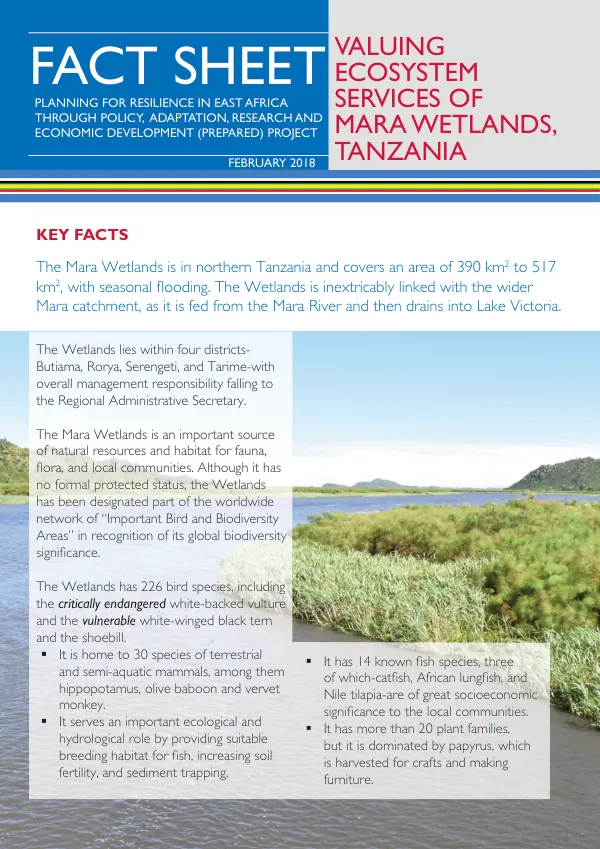
The Mara Wetlands is a vital ecosystem located in northern Tanzania, covering an area of 390 km2 to 517 km2 with seasonal flooding.
2018 · 4 pages
Sign in to readA free account is required to download.
Abstract
The Wetlands is inextricably linked with the wider Mara catchment, as it is fed from the Mara River and then drains into Lake Victoria. The Wetlands lies within four districts: Butiama, Rorya, Serengeti, and Tarime, with overall management responsibility falling to the Regional Administrative Secretary. The Mara Wetlands is an important source of natural resources and habitat for fauna, flora, and local communities. Although it has no formal protected status, the Wetlands has been designated part of the worldwide network of "Important Bird and Biodiversity Areas" in recognition of its global biodiversity significance. The Wetlands is home to 226 bird species, including the critically endangered white-backed vulture and the vulnerable white-winged black tern and the shoebill. It also serves as a habitat for 30 species of terrestrial and semi-aquatic mammals, such as hippopotamus, olive baboon, and vervet monkey. The Wetlands plays a crucial ecological and hydrological role by providing suitable breeding habitat for fish, increasing soil fertility, and sediment trapping. It has 14 known fish species, three of which - catfish, African lungfish, and Nile tilapia - are of great socioeconomic significance to the local communities. The Wetlands is dominated by papyrus, which is harvested for crafts and making furniture. More than 20 plant families are present in the Wetlands. In 2015, the USAID-funded Planning for Resilience in East Africa through Policy, Adaptation, Research, and Economic Development (PREPARED) Project completed an economic valuation of ecosystem services provided by the Mara Wetlands. The assessment used a 10-step approach to complete the ecosystem service assessment, which started with scoping and designing the study, followed by collecting and analyzing data, and finally communicating the findings to decision makers to make the case for conservation. The assessment valued 10 ecosystem services that represent the products, raw materials, primary productivity, and vital life support services that are critical to human well-being and a functioning economy. The values of the services are summarized below: provisioning services, including crop production, water for livestock, water for domestic use, capture fishery, wood and non-timber products, and grass for fodder; regulating and supporting services, including other wetland products, carbon sequestration; and cultural services, including cultural tourism. The total economic value of the Mara Wetlands is USD 5,000,000 per year, providing a strong justification to design, finance, and implement plans and activities that ensure the conservation and sustainable management of the landscape. The PREPARED Project worked with BirdLife International and other key stakeholders in Uganda and Tanzania to develop an Integrated Management Plan (IMP) and Conservation Investment Plan (CIP) for the Wetlands. The goal of the 2017/18–2021/22 Mara Wetlands IMP is to improve the conservation and sustainable management of Mara Wetlands ecosystem for the purpose of securing community livelihoods and building resilience to climate change. The Mara Wetlands CIP is a resource mobilization document that the government of Tanzania can use to solicit funds for the IMP. The CIP prioritizes four bankable investment packages, with a total cost of USD 4,640,000. The cost of implementing the CIP is significantly less than the value of the ecosystem services that are reaped from Mara Wetlands, clearly demonstrating that it pays to conserve.
Related documents