CHEMONICS
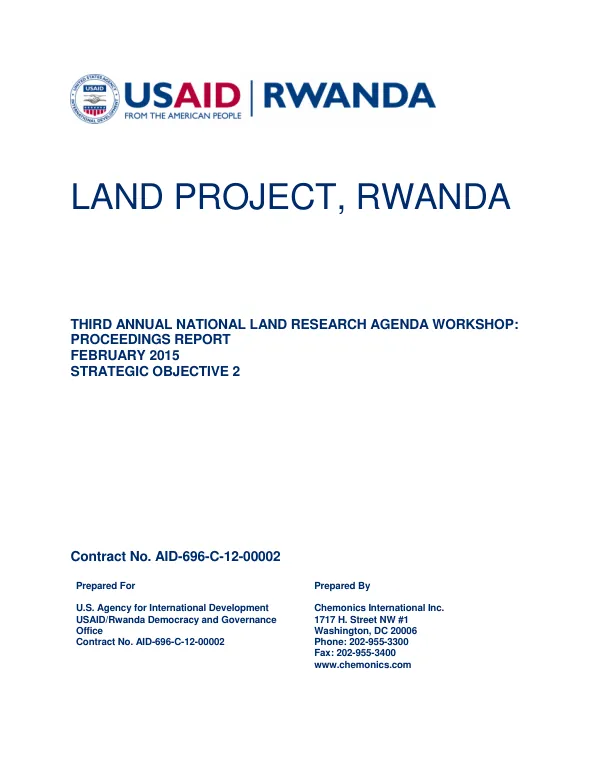
Third Annual National Land Research Agenda Workshop: Proceedings Report
The third annual National Land Research Agenda Workshop was held from January 21st to 23rd, 2015, at Lemigo Hotel.
2015 · 65 pages
Sign in to readA free account is required to download.
Abstract
The workshop was organized by the USAID LAND Project in partnership with the Rwanda Natural Resources Authority (RNRA) and the Institute of Policy Analysis and Research (IPAR-Rwanda). The main objective of the workshop was to identify critical land-related research priorities that the LAND project would support in 2015-2016. The workshop involved a participatory approach, known as the "World Café," where stakeholders from various sectors, including government, private sector, civil society organizations, universities, and research institutions, were invited to participate. The participants were asked to identify research priorities from an initial list of 63 suggestions. The research priorities were evaluated based on several criteria, including relevance to land and land policy, potential to influence policy affecting ordinary Rwandan citizens, cost and complexity of the research, and other factors that might influence the choice of a particular topic. As a result of the workshop, three research priorities were identified as the most crucial. The first priority was to optimize land use for settlement purposes in rural and urban areas. The second priority was to enhance the capacity of small holder farmers and communities to adapt to climate change, which is a major challenge due to marginal land, limited access to agricultural inputs, and reliance on rain-fed agriculture. The third priority was to assess the efficiency of the decentralized land administration system in terms of sustainability, transparency, and delivery. The workshop provided a platform for researchers to present their findings on land issues and receive comments from a multidisciplinary audience. The identified research priorities will soon be developed into clear terms of reference, which will guide the research activities of the LAND project in 2015-2016. The Rwanda Natural Resources Authority (RNRA) plays a crucial role in land administration and management in Rwanda. The authority is responsible for ensuring that land is used efficiently and effectively, and that the rights of landowners are protected. The RNRA works closely with other stakeholders, including the government, private sector, and civil society organizations, to achieve its objectives. The Institute of Policy Analysis and Research (IPAR-Rwanda) is a research institution that provides policy analysis and research services to the government and other stakeholders in Rwanda. The institute works closely with the LAND project to identify research priorities and develop terms of reference for research activities. The USAID LAND Project is a five-year project that aims to improve land administration and management in Rwanda. The project is implemented by Chemonics International Inc. and is funded by the United States Agency for International Development (USAID). The project works closely with the government of Rwanda, the RNRA, and other stakeholders to achieve its objectives. The LAND project has made significant progress in improving land administration and management in Rwanda. The project has supported the development of a new land policy, which aims to promote efficient and effective land use. The project has also supported the establishment of a decentralized land administration system, which aims to improve access to land services for rural communities. The LAND project has also supported research activities on land issues, including the identification of research priorities and the development of terms of reference for research activities. The project has worked closely with researchers and other stakeholders to identify research priorities and develop terms of reference for research activities. The LAND project has also supported the development of a land information management system, which aims to improve access to land information for rural communities. The system provides information on land ownership, land use, and other land-related information. The LAND project has also supported the establishment of a land dispute resolution mechanism, which aims to resolve land disputes in a fair and transparent manner. The mechanism provides a platform for landowners and other stakeholders to resolve land disputes through mediation and arbitration. Overall, the LAND project has made significant progress in improving land administration and management in Rwanda. The project has supported the development of a new land policy, the establishment of a decentralized land administration system, and the development of a land information management system. The project has also supported research activities on land issues and the establishment of a land dispute resolution mechanism.