USAID
Climate Risk in Rwanda: Country Risk Profile
Rwanda's economic growth in recent years has been accompanied by a drop in poverty, with GDP per capita growing almost fourfold from US $201 to US$748 between 2001-2017.
2019 · 5 pages
Sign in to readA free account is required to download.
Abstract
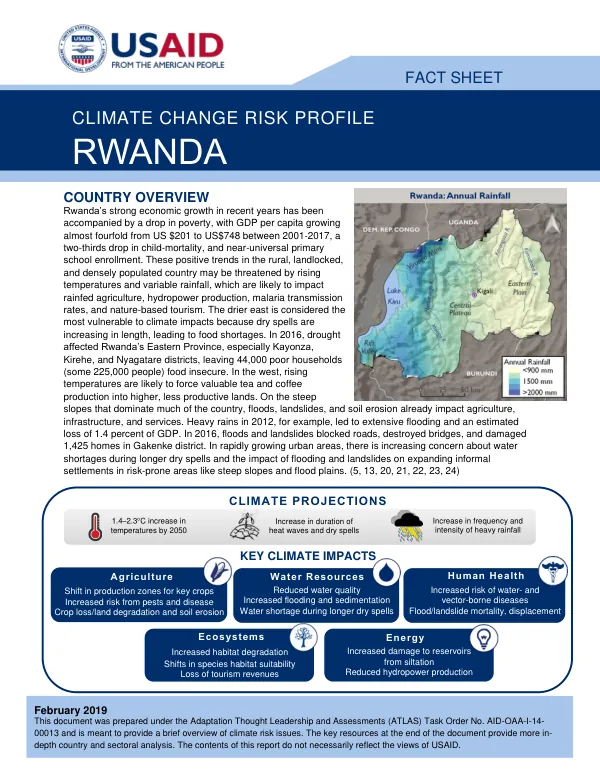
This growth has also led to a two-thirds drop in child-mortality and near-universal primary school enrollment. However, the country's strong economic growth may be threatened by rising temperatures and variable rainfall, which are likely to impact rainfed agriculture, hydropower production, malaria transmission rates, and nature-based tourism. The drier east is considered the most vulnerable to climate impacts because dry spells are increasing in length, leading to food shortages. In 2016, drought affected Rwanda's Eastern Province, especially Kayonza, Kirehe, and Nyagatare districts, leaving 44,000 poor households (some 225,000 people) food insecure. In the west, rising temperatures are likely to force valuable tea and coffee production into higher, less productive lands. On the steep slopes that dominate much of the country, floods, landslides, and soil erosion already impact agriculture, infrastructure, and services. Rwanda is situated in the equatorial zone, with a mountainous terrain (950–4,500 m) and a temperate climate characterized by strong seasonality and high interannual variability. The country's topography moderates temperature and rainfall, leading to large variations over short distances. Rwanda has two rainy seasons, a main season from March to May and a short season from mid-September to mid-December. The El Niño Southern Oscillation influences precipitation periodically, with El Niño bringing above-average rainfall and La Niña, below-average rainfall. The country's climate is projected to change significantly by the 2050s, with an increase in average annual temperature of 1.4–2.3°C, increased duration of heat waves by 7–22 days, and likely increase in average rainfall (range of -3 to +9 percent). The increased heavy rainfall event frequency (7–40 percent) and intensity (2–11 percent) will exacerbate soil erosion and further degrade cultivated lands. Agriculture accounts for more than 30 percent of GDP, employs about 70 percent of the population, and generates about 50 percent of the country's export revenues. Rising temperatures compromise the quality and productivity of highly lucrative, temperature-sensitive tea and coffee, while temperature increases are likely to expand production potential through 2050 for maize, Irish potato, cassava, and sorghum. Rwanda's water resources face increased pressure from a changing climate, with warming temperatures and longer dry spells likely to diminish surface flows, leading to water shortages (particularly in the east and around Kigali) and reduce groundwater recharge. Dry season flows in the Nyabarongo River, which supports Kigali's water supply, are expected to decrease in coming decades, exacerbating shortages already occurring in the capital city. Heavy rainfall also increases siltation of rivers, lakes, and reservoirs, and contaminates industrial, agricultural, and domestic sources.
Related documents