CHEMONICS
Vulnerability Profile: Nyangores Subcatchment
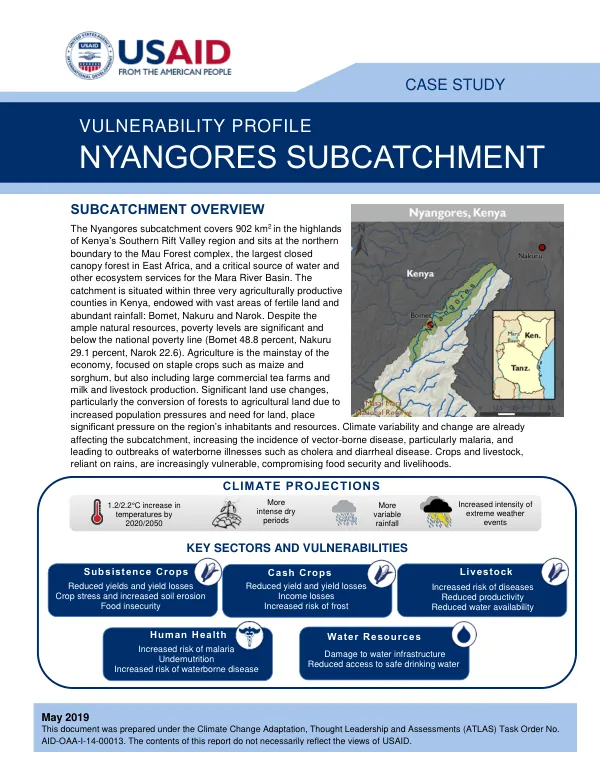
The Nyangores subcatchment covers 902 km2 in the highlands of Kenya's Southern Rift Valley region and sits at the northern boundary to the Mau Forest complex, the largest closed canopy forest in East Africa.
2019 · 12 pages
Sign in to readA free account is required to download.
Abstract
The catchment is situated within three agriculturally productive counties in Kenya: Bomet, Nakuru, and Narok. Despite the ample natural resources, poverty levels are significant, with 48.8 percent of the population in Bomet and 22.6 percent in Narok living below the national poverty line. Agriculture is the mainstay of the economy, focused on staple crops such as maize and sorghum, as well as large commercial tea farms and milk and livestock production. Significant land use changes, particularly the conversion of forests to agricultural land due to increased population pressures and need for land, place significant pressure on the region's inhabitants and resources. Climate variability and change are already affecting the subcatchment, increasing the incidence of vector-borne disease, particularly malaria, and leading to outbreaks of waterborne illnesses such as cholera and diarrheal disease. Crops and livestock, reliant on rains, are increasingly vulnerable, compromising food security and livelihoods. The subcatchment's inhabitants are vulnerable to deforestation, primarily driven by high fertility rates and agricultural expansion. Population densities along the forest margins are well above the average for Kenya, with over 300 people per square kilometer. Agricultural expansion is primarily taking place through the conversion of forest lands to small-scale farming. Forest cover decreased in the Mara River Basin from 20 percent to approximately 7 percent between 1976 and 2014, with the majority of the decrease attributed to deforestation in the Mau Forest complex. Poverty and food insecurity are also critical issues in the subcatchment. The majority of the inhabitants are poor, small-scale farmers who are vulnerable to the vagaries of markets and climate stressors. Almost one-half of the population in Bomet and 22.6 percent in Narok live below the national poverty line. Food insecurity is a critical issue in Bomet, particularly between January and April, when harvested stocks are generally depleted. Increasingly unreliable growing seasons, due to climate change, are also affecting the subcatchment. The length of time that soil temperature and soil moisture conditions are suitable for cash and subsistence crops is changing, with delayed starts and more frequent failure of the short rains, making for less reliable growing seasons. Farmers now plant maize throughout the year, rather than relying on the historical long rains, which have become increasingly unreliable. The community-identified vulnerabilities in the Nyangores subcatchment include drought and disease, particularly in the upper Nyangores, and drought and flooding in the lower Nyangores. Maize and potato were seen as the resources most at risk from climate change, respectively ranked "highly vulnerable" to droughts and disease and "moderately vulnerable" to land use change and flooding. Several opportunities to increase the resilience of the subcatchment inhabitants should be prioritized and supported. Alternative livelihoods and poverty reduction activities, such as avocado, passion fruit, and banana production, and dairy goat farming, are being implemented with early results offering promising outcomes. Resource protection activities, such as woodlots and home-based biogas digestors, and soil and water conservation measures, such as mulching and planting cover crops, are also being implemented to reduce deforestation and encroachment into the Mau Forest complex.