FAMILY HEALTH INTERNATIONAL 360
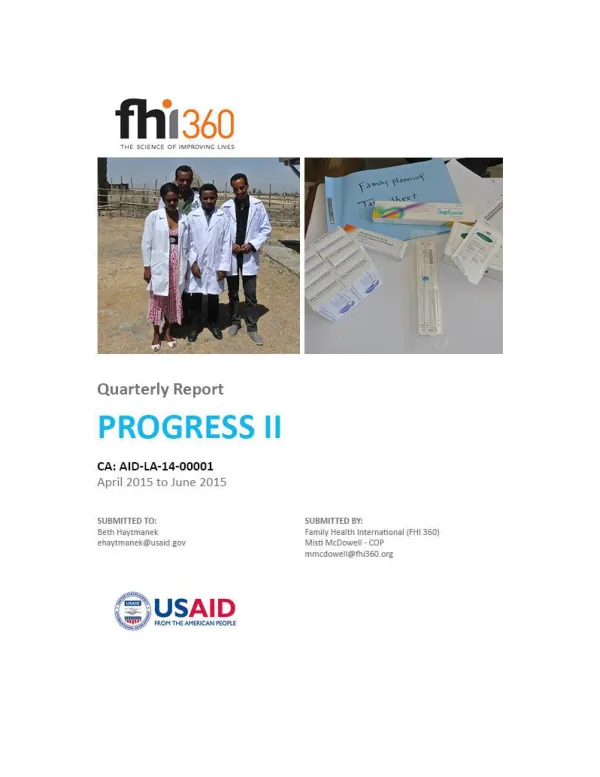
Third Quarter Activity Report: PROGRESS Follow-on Program (PROGRESS II)
The PROGRESS Follow-on Program (PROGRESS II) is a USAID-funded initiative aimed at strengthening the capacity of the Ethiopian Federal Ministry of Health (FMOH) to monitor and evaluate family planning programs.
2014 · 12 pages
Sign in to readA free account is required to download.
Abstract
The program began in December 2013 and is set to conclude in December 2017, with a budget of $4,200,000. The program focuses on six key areas, including enhancing the monitoring component of the Centers of Excellence, expanding the geographical reach of the Centers of Excellence, and providing technical assistance to the FMOH. During the third quarter of the FY14 implementation period, the PROGRESS II team conducted supportive supervision of existing Centers of Excellence in four regions and established new CoEs in five regions, including three pastoralist regions. The team successfully conducted supportive supervision in 11 woredas and 31 health centers in SNNP, Amhara, Oromia, and Benishangul Gumuz regions. The supervision was conducted by FHI 360 staff accompanied by Regional, Zonal, and Woreda Health officials, and assessed the readiness of the M&E team at the woreda and health center level to use the HMIS, including data management and reporting practices. The PROGRESS II team also held discussions and drafted memoranda of understanding (MOUs) with Somali, Gambella, and Afar regions to establish new CoEs. Twelve new CoE woredas have been identified and are in different stages of establishment. Additionally, a successful dissemination event highlighting key achievements under PROGRESS I was organized and conducted in Addis Ababa in collaboration with the FMOH and the Amhara RHB. The program's technical assistance strategy is focused on building capacity of the Ministry of Health staff at Federal, Regional, Zonal, and Woreda levels. Technical assistance and collaboration focus on monitoring and evaluating the results of the Implanon and IUCD interventions. FHI 360 will provide trainings on M&E, extraction and analysis of family planning service delivery data to support the decision-making process, and establishing additional FP M&E centers of excellence in selected Woredas. The PROGRESS II program has made significant progress in enhancing the monitoring component of the Centers of Excellence, expanding the geographical reach of the Centers of Excellence, and providing technical assistance to the FMOH. The program's focus on building capacity of the Ministry of Health staff and providing technical assistance has contributed to the improvement of family planning programs in Ethiopia. The program's achievements are expected to have a positive impact on the country's health sector, particularly in the area of family planning. The PROGRESS II team has also made progress in establishing new CoEs in five regions, including three pastoralist regions. The team has successfully conducted supportive supervision in 11 woredas and 31 health centers, and has assessed the readiness of the M&E team at the woreda and health center level to use the HMIS. The program's technical assistance strategy has focused on building capacity of the Ministry of Health staff at Federal, Regional, Zonal, and Woreda levels, and has provided trainings on M&E, extraction and analysis of family planning service delivery data, and establishing additional FP M&E centers of excellence. The PROGRESS II program's achievements are expected to have a positive impact on the country's health sector, particularly in the area of family planning. The program's focus on building capacity of the Ministry of Health staff and providing technical assistance has contributed to the improvement of family planning programs in Ethiopia. The program's progress in establishing new CoEs and conducting supportive supervision has also contributed to the improvement of family planning programs in the country.