USAID DEC
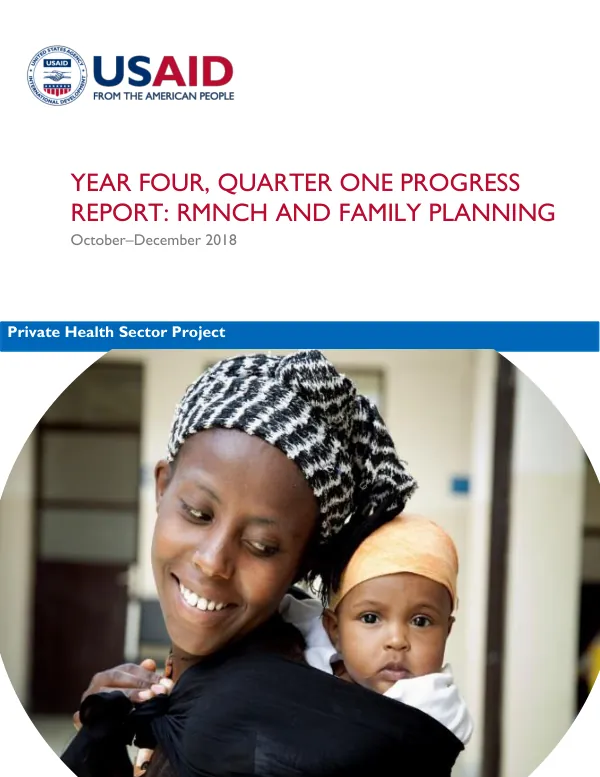
Year Four, Quarter One Progress Report: RMNCH and Family Planning (October – December 2018)
Sign inABT ASSOCIATES
Year Four, Quarter One Progress Report: RMNCH and Family Planning (October – December 2018)
The Private Health Sector Project (PHSP) is a technical assistance project that supports the Government of Ethiopia in improving the quality of and access to family planning (FP) and maternal, neonatal, and child health (MNCH) services.
2018 · 32 pages
Sign in to readA free account is required to download.
Abstract
The project is managed by Abt Associates Inc. and is funded by the United States Agency for International Development (USAID) under Contract No. A-663-LA-00001. The project aims to address the gap in service provision and access to quality FP and MNCH services in 52 private health facilities in Addis Ababa, Dire Dawa, Harari, Amhara, Oromia, Southern Nations, Nationalities, and Peoples Region (SNNPR), and Tigray regions and city administrations. The project provides a wide range of technical support, including trainings, mentorship support, and joint supportive supervision (JSS) to address the gap in service provision. In the reporting quarter, the project conducted health facility readiness assessments in collaboration with the Regional Health Bureaus (RHBs) in 118 facilities from Afar, Benshangul Gumuz, and Gambella. The assessments identified 41 facilities that are eligible for technical support in integrated management of newborn and child health (IMNCI). The facilities will start delivering IMNCI services according to the national guideline after receiving technical support from the project. The project also assessed and enrolled 52 private health facilities from Addis Ababa, Dire Dawa, Harari, Amhara, Oromia, SNNPR, and Tigray regions and city administrations. The facilities will receive technical support, including trainings, mentorship support, and JSS, to address the gap in service provision. The project's goals are aligned with the Health Sector Transformation Plan, which aims to reduce the maternal mortality ratio (MMR) to 276 per 100,000 live births, increase the contraceptive prevalence rate (CPR) to 55%, and reduce the total fertility rate (TFR) to 3 by the end of 2020. The project's objectives are to improve the quality of and access to FP and MNCH services, particularly in private health facilities. The project's progress in the reporting quarter includes: * Conducted health facility readiness assessments in 118 facilities from Afar, Benshangul Gumuz, and Gambella. * Identified 41 facilities that are eligible for technical support in IMNCI. * Assessed and enrolled 52 private health facilities from Addis Ababa, Dire Dawa, Harari, Amhara, Oromia, SNNPR, and Tigray regions and city administrations. * Provided basic emergency obstetric and neonatal care (BEmONC) training to midwives in 52 facilities. The project's achievements in the reporting quarter demonstrate its commitment to improving the quality of and access to FP and MNCH services in private health facilities in Ethiopia.