ABT ASSOCIATES
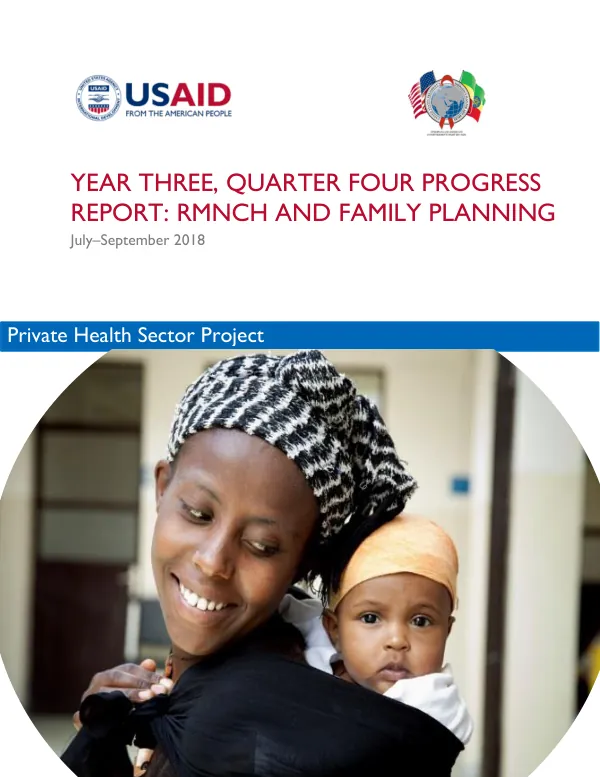
Year Three, Quarter Four Progress Report: RMNCH and Family Planning
The Private Health Sector Project is a technical assistance project to support the Government of Ethiopia.
2018 · 26 pages
Sign in to readA free account is required to download.
Abstract
The project is managed by Abt Associates Inc. and is funded by the United States Agency for International Development (USAID), under Contract No. AID-663-LA-16-00001. The project aims to improve the delivery of reproductive, maternal, neonatal, and child health (RMNCH) services and family planning (FP) in private health facilities across Ethiopia. The project focuses on 30 private health facilities in Addis Ababa, Dire Dawa, Harari, Amhara, Oromia, Southern Nations, Nationalities, and Peoples (SNNP), and Tigray regions and city administrations. Recently, the project assessed and enrolled 22 additional facilities from Addis Ababa and Oromia, provided training on basic emergency obstetric and newborn care (BEmONC) for midwives, and is in the process of signing a memorandum of understanding (MoU) with the facilities and Regional Health Bureaus (RHBs). The project improves service provision in 125 supported facilities by integrating FP into existing antiretroviral therapy (ART), prevention of mother-to-child transmission (PMTCT), and RMNCH services or as a stand-alone modality with additional options of long-acting methods such as implants and intra-uterine contraceptive devices (IUCDs). To achieve this, the project provides basic training and onsite support through mentorship to providers to build their clinical, counseling, and joint supportive supervision (JSS) skills. The project also links private facilities to their respective RHBs and Pharmaceuticals Fund and Supply Agency (PFSA) hubs to access FP commodities and provide services at an affordable fee. The project uses the following strategies to achieve its goal: advocating and supporting the Federal Ministry of Health (FMoH) and RHBs to engage private facilities providing RMNCH-FP services through public-private mix (PPM); creating a common understanding with FMoH, RHBs, and PFSA to facilitate and increase access to FP commodities and selected RMNCH essential drugs; supporting private facilities to implement standardized RMNCH-FP services in line with national standards; and conducting different capacity-building competency-based training programs for providers. The project has made significant progress in improving the delivery of RMNCH services and FP in private health facilities across Ethiopia. The project has trained over 2,500 providers on BEmONC and FP, and has supported the integration of FP into existing services in 125 facilities. The project has also linked private facilities to RHBs and PFSA hubs to access FP commodities and provide services at an affordable fee. The project's RMNCH-FP programs support the private health sector to enhance the delivery of quality and priority healthcare services. The project's strategies have been effective in improving the delivery of RMNCH services and FP in private health facilities across Ethiopia. The project's progress has been significant, and it is expected to continue making a positive impact on the health outcomes of women and children in Ethiopia. The project's success can be attributed to its effective strategies, which include advocating and supporting the FMoH and RHBs to engage private facilities providing RMNCH-FP services through PPM; creating a common understanding with FMoH, RHBs, and PFSA to facilitate and increase access to FP commodities and selected RMNCH essential drugs; supporting private facilities to implement standardized RMNCH-FP services in line with national standards; and conducting different capacity-building competency-based training programs for providers. The project's impact on the health outcomes of women and children in Ethiopia is expected to be significant. The project's RMNCH-FP programs are expected to improve the delivery of quality and priority healthcare services, reduce maternal and child mortality rates, and increase access to FP commodities and services. The project's success will depend on its ability to continue implementing its effective strategies and building on its progress to date.