INTERNATIONAL RESCUE COMMITTEE
Third Quarterly Report: Emergency Food Security Program in Niger
The Emergency Food Security Program in Niger, implemented by the International Rescue Committee (IRC), aimed to restore or strengthen households' livelihoods and their ability to withstand ongoing food insecurity shocks in Diffa region.
2019 · 13 pages
Sign in to readA free account is required to download.
Abstract
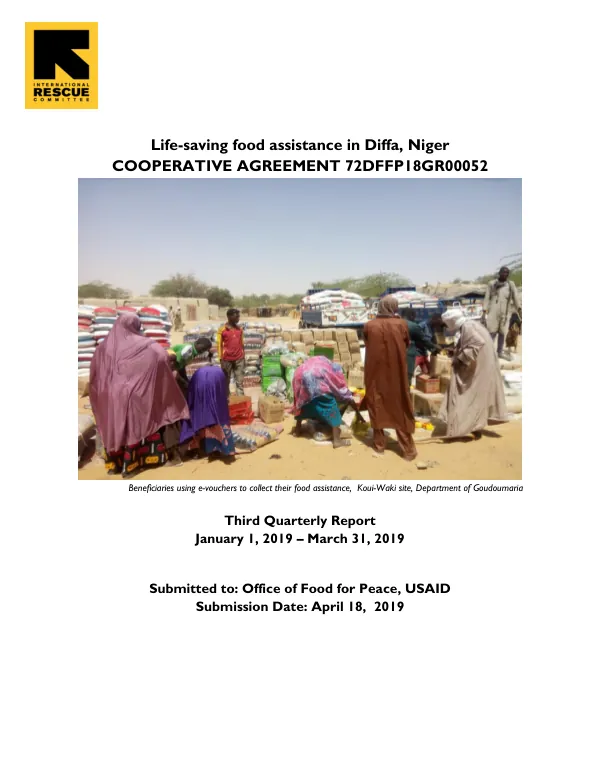
The program targeted 3,400 households, with 1,431 male heads of household and 1,969 female heads of household, representing 39.5% host community members and 60.5% displaced people, including 12.9% refugees, 6.1% returnees, and 41.5% internally displaced people. The program continued to provide food assistance through e-voucher exchange, with three distributions held in January, February, and March 2019. Each beneficiary's e-voucher was credited with an amount in local currency equivalent to USD 58, and all 3,400 beneficiaries attended and redeemed their e-vouchers each month. The IRC also organized a fair and distributed e-vouchers to the 1,421 beneficiaries who missed the first distribution due to the delay in the beneficiary identification process. In addition to food assistance, the IRC conducted awareness-raising sessions on nutrition and infant and young child feeding (IYCF) and malnutrition screening for children and women. Prior to each e-voucher distribution, sensitization sessions were held for beneficiaries on the importance of IYCF best practices, dietary diversification, and handwashing, as well as on the e-voucher exchange process. During the quarter under review, 10,473 persons were sensitized, including 5,954 women and 4,519 men. The IRC also screened children aged 6 to 59 months and pregnant and lactating women for malnutrition prior to each e-voucher distribution. Of the 1,128 children and 1,046 women screened in February and March, 88 children and 120 women were considered to be malnourished. Children in the green category were considered healthy, while children in the yellow and red categories were suspected cases of moderate acute malnutrition (MAM) and severe acute malnutrition (SAM), respectively. SAM cases were referred to the nearest health center for verification and further examination and care. The IRC also participated in a meeting of the Multi Sectorial Cash Working Group (MSCWG) at the OCHA office, where World Vision provided an update on the former cash transfer feasibility study in Diffa and discussed it with participants. WFP also informed participants about the level of progress of the Minimum Expenditure Basket (MEB) assessments, of which the IRC is a major player. Participants in the meeting also made amendments to the 4W matrix, which provides an overview of the program's progress. The security situation in Diffa region remained volatile and unpredictable, with 56 security incidents reported between January and March 2019, including kidnappings, robberies, and killings. The increase in the number of displaced people, coupled with the 2018 cereal and crop production deficit, has strained host communities' already scarce resources, including food reserves, fodder, water, and natural resources. The 2019 Humanitarian Response Plan (HRP) estimates that there will be 289,211 people in food insecurity in the region of Diffa in 2019, including 120,000 refugees, 104,000 IDPs, and nearly 26,000 returnees and a large proportion of the host population.
Related documents