USAID DEC
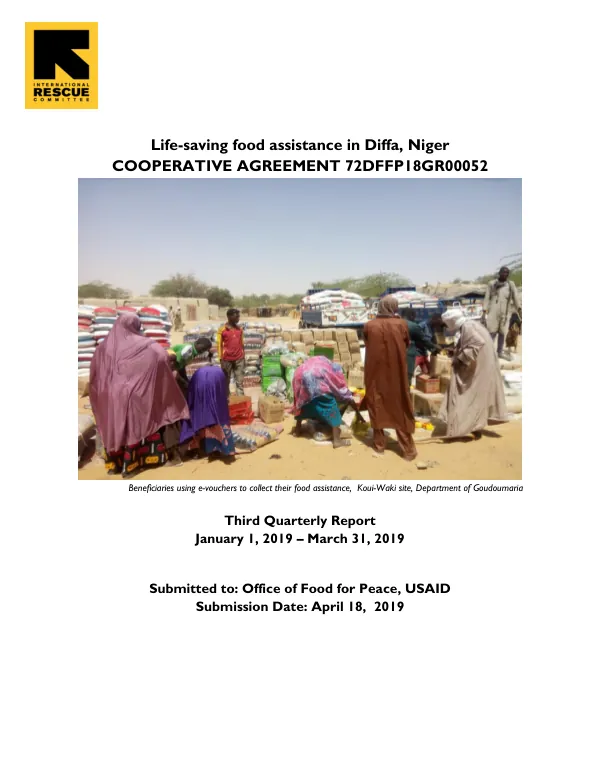
Food Assistance Program for Displaced and Climate Shock Affected Households in Diffa, Niger
Sign inINTERNATIONAL RESCUE COMMITTEE
Food Assistance Program for Displaced and Climate Shock Affected Households in Diffa, Niger
The Food Assistance Program for Displaced and Climate Shock Affected Households in Diffa, Niger was implemented by the International Rescue Committee, Inc.
2021 · 32 pages
Sign in to readA free account is required to download.
Abstract
in partnership with the USAID Bureau for Humanitarian Assistance. The program aimed to provide food assistance to vulnerable households affected by displacement and climate shocks in the Diffa region of Niger. The program targeted 3,700 households, including 900 households in Maine Soroa and N'Gourti who received three months of unconditional food e-vouchers, and 2,800 households in Chetimari and Gueskerou municipalities who received five months of e-voucher distribution. The beneficiaries were disaggregated by gender and head of household, with 1,925 female-headed households and 1,775 male-headed households. The program also provided income generation activity start-up cash to 270 women, individual and group development accounts. The security situation in Diffa remained unstable from June 2020 to May 2021, with armed opposition groups attacking military and government positions, deploying improvised explosive devices, and kidnapping civilians. The population movements in the region were significant, with 515 households (2,783 people) making inter-site movements in March 2021, and 1,559 households (9,859 people) identified as on the move during the first quarter of 2021. The program implemented activities despite the challenging factors in the area, including the distribution of unconditional food e-vouchers to 900 households in climate-shock affected areas, and the provision of conditional food e-vouchers to 700 households for agricultural and pastoral land restoration practices. The program also provided support to 28 Infant and Young Children Feeding (IYCF) groups, and conducted a Post-Distribution Monitoring Survey and a project endline evaluation. The COVID-19 pandemic had a significant impact on the region, with a second wave starting in November 2020 and a total of 3,405 new positive cases identified up to early February 2021. However, the Nigerien government's mitigation strategies led to a significant decrease in new cases, with weekly cumulative incidence falling from 1.8 per 100,000 inhabitants in the first week of January to 0.43 per 100,000 inhabitants in the first week of February 2021. The program's results showed a total of 3,700 households targeted, with 1,925 female-headed households and 1,775 male-headed households. The program also provided income generation activity start-up cash to 270 women, individual and group development accounts. The program's activities were implemented despite the challenging factors in the area, and the results showed a significant impact on the beneficiaries. The program's average cost per project participant was $118.71, with an average cost per project participant per month of $16.9. The program's results showed a significant impact on the beneficiaries, with a total of 5,211 children under two years old screened during the project implementation period. The program also conducted a Post-Distribution Monitoring Survey and a project endline evaluation, which provided valuable insights into the program's effectiveness and impact. The program's geographic focus was on the Diffa region of Niger, with a specific focus on the municipalities of Maine Soroa, N'Gourti, Chetimari, and Gueskerou. The program's timeframes were from June 2020 to May 2021, with a specific focus on the second wave of COVID-19 in Niger. The program's recommendations included the need for continued support to vulnerable households affected by displacement and climate shocks, and the importance of implementing mitigation strategies to prevent the spread of COVID-19.