CARE
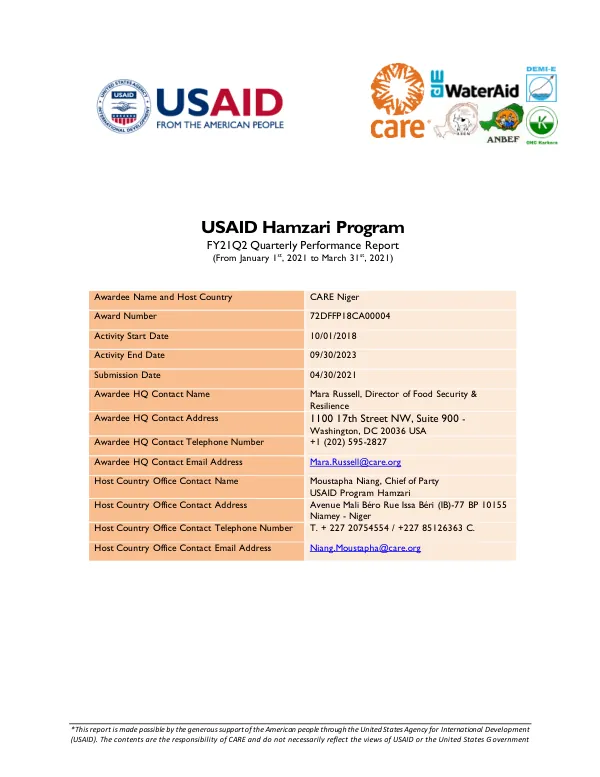
FY21 Q3 Performance Report: USAID Hamzari Program in Niger
The Hamzari Program in Niger is a USAID-funded initiative aimed at achieving sustainable, equitable, and resilient food and nutrition security for vulnerable groups in the Maradi region.
2021 · 27 pages
Sign in to readA free account is required to download.
Abstract
The program targets all vulnerable households in three communes: Chadakori, Guidan Sori, and Guidan Roumdji in the Guidan Roumdji Department. The overall goal is to reduce extreme vulnerability for women, youth, and marginalized households in Maradi. The program has four main purposes: to reduce extreme vulnerability, improve nutritional status, improve access and use of equitable and sustainable WASH services, and enhance sustainable diversified livelihood opportunities. The target beneficiaries include 22,400 unique direct participant households, with a breakdown by program element for FY21. The program is led by CARE Niger, with technical partners including WaterAid, Karkara, AREN, ANBEF, and DEMI-E. The security situation in Niger remained volatile and precarious over the reporting period, with small-scale attacks and banditry reported along the borders with Nigeria, Mali, and Burkina Faso. Despite these challenges, the program continued to implement its activities, with a focus on technical activities, program management, partnerships, collaborations, and linkages. Technical activities included farmer training programs, infrastructure development, and market linkage facilitation. The program also focused on improving maternal and child health, nutrition, family planning and reproductive health, water supply and sanitation, environment, agriculture, financial sector, civil society, climate change adaptation, disaster readiness, and social assistance. The program's technical partners provided leadership and advice on various aspects of the program, including the development of technical tools and guides, training, supervision, monitoring, and quality control. CARE Niger is responsible for overall program coordination and accomplishments of all target objectives, including financial management, sub-recipient management, and compliance with donor procedures and U.S. Government regulations. The program's quarterly performance update for FY21 Q3 reported a total of 22,400 unique direct participant households, with a breakdown by program element. The report also highlighted the program's achievements, including the training of over 2,500 farmers in sustainable agriculture techniques and the establishment of demonstration plots that showed yield improvements of 60% when applying recommended practices. The program's plans for the next quarter included continued implementation of technical activities, program management, partnerships, collaborations, and linkages. The program's challenges and lessons learned included the security situation in Niger, which posed a significant risk to program implementation. The program also faced challenges in implementing certain technical activities, including irrigation techniques, due to equipment costs. However, the program's technical partners provided valuable support and guidance, and the program was able to adapt and respond to these challenges. Overall, the Hamzari Program in Niger is a critical initiative aimed at achieving sustainable, equitable, and resilient food and nutrition security for vulnerable groups in the Maradi region. Despite the challenges posed by the security situation, the program has made significant progress in implementing its activities and achieving its objectives.