USAID DEC
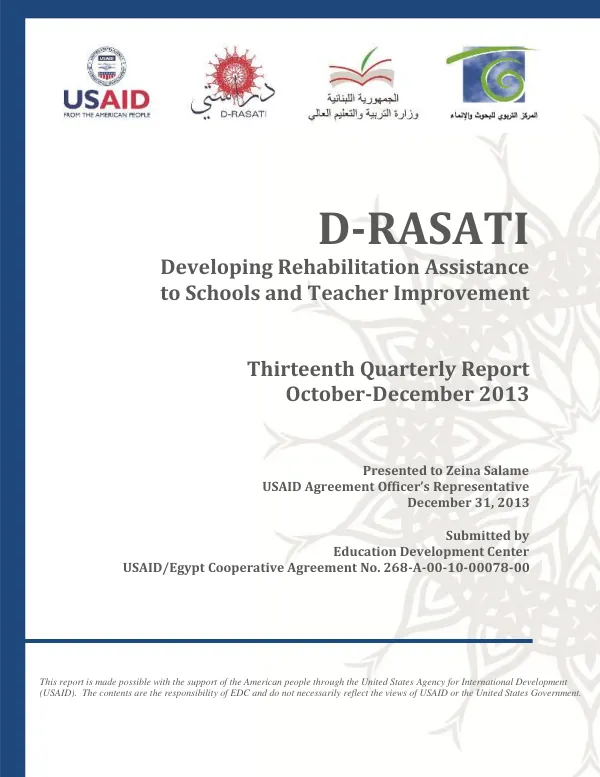
Thirteenth Quarterly Report: Developing Rehabilitation Assistance to Schools and Teacher Improvement
Sign inCENTER FOR EDUCATIONAL DEVELOPMENT
Thirteenth Quarterly Report: Developing Rehabilitation Assistance to Schools and Teacher Improvement
The D-RASATI project, Developing Rehabilitation Assistance to Schools and Teacher Improvement, was a USAID-funded initiative aimed at improving the Lebanese public education system.
2013 · 32 pages
Sign in to readA free account is required to download.
Abstract
The project's main objective was to enhance the quality of education by rehabilitating school facilities, improving teacher training, and increasing learning opportunities for students. The project's technical achievements were significant, with a focus on assessment, school learning environments, and increased learning opportunities. In the assessment component, teacher standards were finalized and submitted to the Ministry of Education and Higher Education (MEHE) in October 2011. Teacher trainer standards were also finalized and submitted to MEHE in December 2013. The Progress Scale field test report was submitted in December 2013. In the school learning environments component, rehabilitation work and handover of schools were completed, with 149 schools receiving certification of completion from Construction Management Services (CMS). However, due to security concerns, some schools were handed over without certification. Publicity events and activities were held to highlight the project's success stories, including the rehabilitation of Kfarhabou Public School and environmental compliance in the rehabilitated schools. The project also conducted 27 school maintenance regional meetings to hand over the school maintenance manual and orient school principals on its effective usage. A total of 681 school principals attended the meetings, while 593 principals did not. The project ensured the delivery of the school maintenance manual to the principals who did not attend the meetings. In terms of increased learning opportunities, the project piloted Teacher Learning Circles (TLCs) in 13 schools, with participants expressing their satisfaction with the activity and commitment to continuing the approach in public schools. The project also finalized teacher and trainer standards to support the long-term integration and alignment of the professional development system. The project's impact was significant, with 113,307 children, 388 schools, and 1,031 system educators benefiting from its intervention. The Lebanese public education system was notably different as a result of D-RASATI's contributions, with tangible improvements in school facilities and infrastructure, greatly improved secondary science labs, clear expectations for teachers and trainers, and enhanced instructional resources and products to support high-quality teaching and learning. The project's success was a testament to the effectiveness of closer partnerships between host country governments and international donors. As USAID's largest-ever investment in education in Lebanon, D-RASATI served as a model for future partnerships and collaborations in education development. The project's achievements were recognized through various events and activities, including a high-level field visit by USAID Administrator Dr. Rajiv Shah to Dhour El Shweir Secondary Public School, which had undergone rehabilitation under D-RASATI. The project's success stories were also highlighted through publicity events and activities, showcasing the positive impact of the project on the Lebanese public education system. Overall, the D-RASATI project was a significant achievement in education development, demonstrating the potential for collaborative efforts to improve the quality of education and enhance learning opportunities for students.