USAID DEC
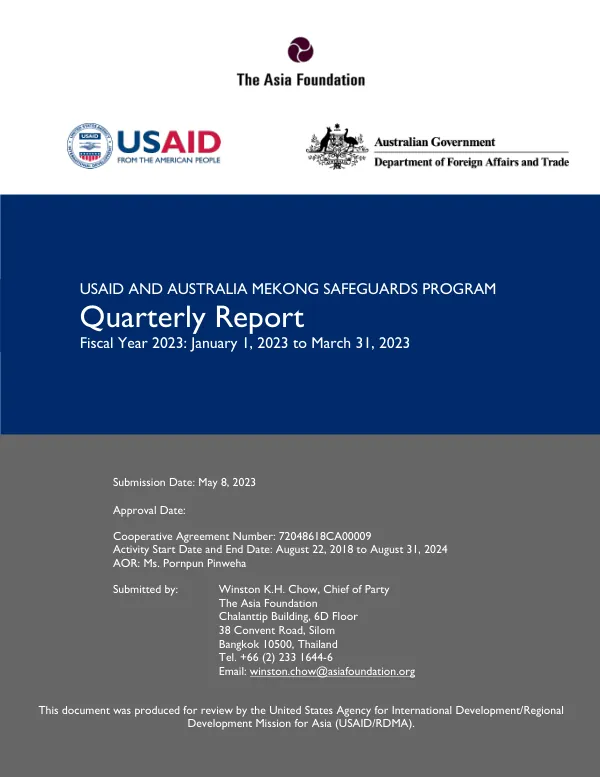
USAID and Australia Mekong Safeguards Program Quarterly Report – Fiscal Year 2023: January 1, 2023-March 31, 2023
Sign inTHE ASIA FOUNDATION
USAID and Australia Mekong Safeguards Program Quarterly Report – Fiscal Year 2023: January 1, 2023-March 31, 2023
The USAID and Australia Mekong Safeguards Program is a six-year initiative that aims to promote the consistent application of strengthened environmental and social governance standards in the Mekong subregion.
2023 · 50 pages
Sign in to readA free account is required to download.
Abstract
The program supports policymakers, government regulators, major financiers, developers, contractors, and communities with technical assistance, knowledge, and tools to foster sustainable infrastructure development. The program focuses on the energy, transport, and water sectors, and its vision is aligned with the national green-growth strategies and regional platforms of the Mekong subregion countries. The program has been implemented since August 2018 and is expected to continue until August 2024. The program is led by The Asia Foundation, with sub-awardees including The Henry L. Stimson Center, Global Environmental Institute, China International Contractors Association, and Beijing Rongzhi Corporate Social Responsibility Institute. The program's geographic coverage includes Cambodia, Lao PDR, Myanmar, Thailand, and Vietnam. The program's objectives are to operationalize the vision of sustainable infrastructure development in the Mekong subregion, promote profitable economic growth supported by sustainable infrastructure, and mitigate the negative impacts of infrastructure development on the environment and local communities. The program's activities include promoting regional dialogue and knowledge exchange, enhancing sustainable infrastructure development and planning, accelerating environmental, social, and governance policies in the Mekong subregion, and strengthening environmental and social standards and practices for the private sector. The program has made significant progress in its first quarter of fiscal year 2023, with notable highlights including the completion of a regional dialogue and knowledge exchange event, the development of a sustainable infrastructure development and planning framework, and the acceleration of environmental, social, and governance policies in the Mekong subregion. The program has also strengthened its partnerships with key stakeholders, including government agencies, civil society organizations, and private sector companies. The program's implementation progress is being closely monitored and evaluated, with a focus on tracking key performance indicators and assessing the program's impact on the environment and local communities. The program's adaptive management approach allows for flexibility and responsiveness to changing circumstances, ensuring that the program remains effective and efficient in achieving its objectives. The program's contributions to USAID's Regional Development Cooperation Strategy (RDCS) relevant key issues include economic opportunity, climate change and environment, gender equality and women's empowerment programs, investing in people, management priorities, research, science, technology, and innovation, and security. The program's activities and events in the next quarter will focus on continuing the program's momentum, building on its achievements, and addressing emerging challenges and opportunities. The program's monitoring, evaluation, and learning (MEL) framework is designed to track the program's progress and assess its impact on the environment and local communities. The program's performance management plan has been updated to reflect the program's revised objectives and indicators, and the program's indicator reporting system is being used to track key performance indicators and assess the program's progress. Overall, the USAID and Australia Mekong Safeguards Program is making significant progress in promoting sustainable infrastructure development and mitigating the negative impacts of infrastructure development on the environment and local communities in the Mekong subregion. The program's adaptive management approach, strong partnerships, and focus on key performance indicators and impact assessment ensure that the program remains effective and efficient in achieving its objectives.
Related documents