USAID
Tips for Implementing USAID Programs
The program implementation framework emphasizes the importance of effective communication and collaboration between USAID and local operators.
2016 · 2 pages
Sign in to readA free account is required to download.
Abstract
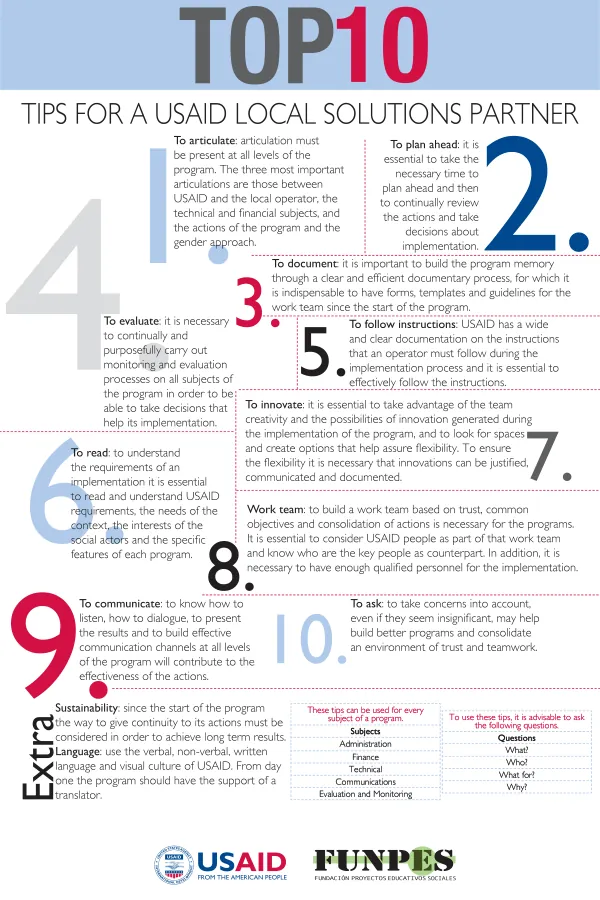
To achieve this, USAID provides guidance on key principles and best practices that can be applied across various subjects, including administration, finance, technical, communications, evaluation and monitoring. Understanding the context is crucial for successful program implementation. USAID has worldwide general guidelines that apply in all contexts, providing clarity and ease of implementation. However, it is essential to read the context and its characteristics to determine the specificities of the program. For instance, in contexts of violence, the communications Waiver is important to ensure the safety of the team and participants. Effective communication is vital for program success. USAID emphasizes the importance of knowing how to communicate, listen, and dialogue with the operator. Building effective communication channels contributes to the efficiency of actions and helps in the documentation and implementation processes. This includes sharing experiences, possible solutions, and contributions for innovation. Collaboration and teamwork are also essential for program implementation. USAID encourages building a work team with the operator to consolidate actions and generate trust relationships. This involves sharing experiences, possible solutions, and contributions for innovation. Continual follow-up meetings are necessary to discuss progress, eventual problems, and questions. Time management is a critical element for the operator, and USAID takes this into account as a transversal axis of the implementation. The operator requires timely answers to proceed with the implementation, and USAID should aim to provide these answers within the shortest possible time. The use of language is also a crucial aspect of program implementation. USAID has a specific use of verbal, non-verbal, and written language, as well as a visual culture that characterizes the way to use communication channels. It is essential for the operator to adapt to this language from the start of the program to ensure effective communication and collaboration. In addition to these principles, USAID encourages the use of tools, formats, and contextualized guidelines that respond to USAID requirements and the needs of the context. Socialization and use of these tools will help the operator to better carry out the implementation and make the review process by USAID more efficient. Furthermore, USAID emphasizes the importance of flexibility in program implementation. The operator may take advantage of creativity and innovation possibilities that may be generated during the implementation. USAID should be flexible to receive and approve proposals that are relevant, justified, and documented. Finally, USAID officials' visits to the field are an important learning opportunity to understand the context and the decisions of the operator. This can generate new proposals to improve the implementation. Key factors to make these visits possible are planning ahead and in an articulate manner with the operator, and knowing and following the travel authorization procedure of USAID.
Related documents