DEVTECH SYSTEMS, INC.
Toolkit for the Early-Grade Reading Assessment Adapted for Zambia
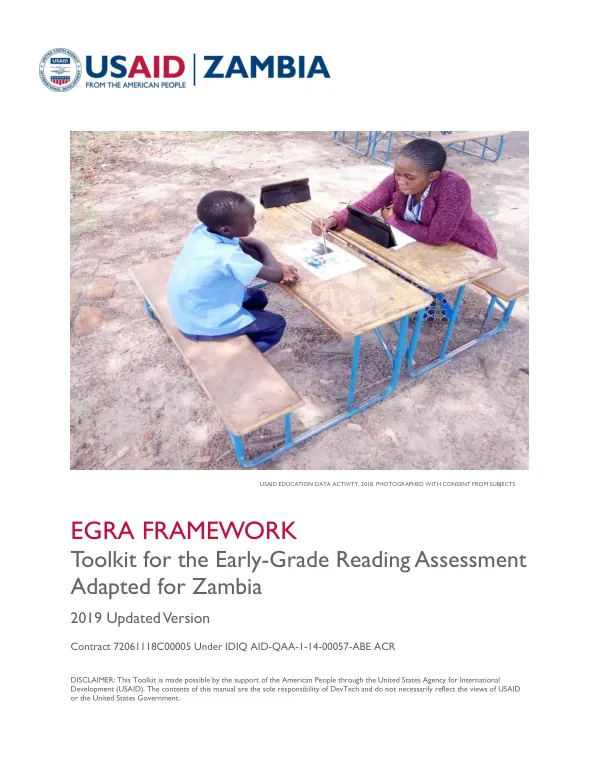
The Early-Grade Reading Assessment (EGRA) framework is a toolkit designed to assess the reading skills of early-grade students in Zambia.
2019 · 110 pages
Sign in to readA free account is required to download.
Abstract
The EGRA instrument is a diagnostic tool that measures various aspects of reading, including phonological awareness, alphabetic principle, phonics, decoding, vocabulary, oral language, fluency, and comprehension. The EGRA framework is based on a conceptual framework that outlines the skills necessary for successful reading. These skills include phonological awareness, alphabetic principle, phonics, decoding, vocabulary, oral language, fluency, and comprehension. The framework also highlights the importance of phonological awareness, which is the ability to hear and manipulate the sounds in words. The EGRA instrument is designed to be adapted to the local context and language of the country where it is being implemented. In Zambia, the instrument was adapted to assess reading skills in the local languages, including Cinyanja, Silozi, Lunda, Icibemba, and Luvale. The instrument consists of various subtasks, including listening comprehension, letter sound identification, syllable fluency, non-word reading, and oral reading passage with reading comprehension. The EGRA framework emphasizes the importance of quality control and assessor training. Quality control officers (QCOs) are responsible for ensuring that the assessment is administered correctly and that the data is accurate. Assessors are trained to administer the assessment and to score the students' responses. The training program includes a review of the EGRA instrument, practice administering the assessment, and feedback on scoring. The EGRA framework also emphasizes the importance of data analysis and reporting. The data collected from the assessment is analyzed to identify trends and patterns in reading skills. The results are then reported to stakeholders, including policymakers, educators, and parents. The framework provides guidelines for data analysis and reporting, including the use of descriptive statistics, regression analysis, and benchmarking. The EGRA framework has been implemented in various countries, including Zambia, Kenya, and Tanzania. The framework has been adapted to assess reading skills in different languages and contexts. The results of the assessment have been used to inform education policy and to improve reading instruction in schools. The EGRA framework is a valuable tool for assessing reading skills in early-grade students. The framework provides a comprehensive approach to reading assessment, including phonological awareness, alphabetic principle, phonics, decoding, vocabulary, oral language, fluency, and comprehension. The framework emphasizes the importance of quality control, assessor training, and data analysis and reporting. The results of the assessment have been used to inform education policy and to improve reading instruction in schools. The EGRA framework has several key components, including the EGRA instrument, quality control, assessor training, data analysis and reporting, and implementation. The EGRA instrument is a diagnostic tool that measures various aspects of reading. Quality control is essential to ensure that the assessment is administered correctly and that the data is accurate. Assessor training is critical to ensure that assessors are competent to administer the assessment and to score the students' responses. Data analysis and reporting are essential to identify trends and patterns in reading skills and to inform education policy.