USAID
Tourism and Antiquities Preservation in Egypt
Egypt's antiquities are a vital component of its cultural heritage and a significant economic asset, generating jobs and income.
2015 · 2 pages
Sign in to readA free account is required to download.
Abstract
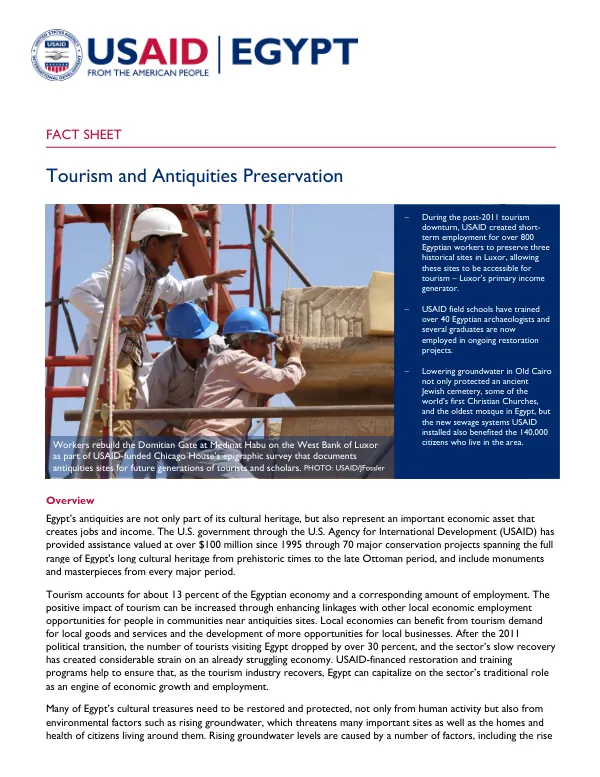
The U.S. government, through the U.S. Agency for International Development (USAID), has provided over $100 million in assistance since 1995 for 70 major conservation projects spanning Egypt's long cultural heritage. These projects include monuments and masterpieces from every major period, from prehistoric times to the late Ottoman period. Tourism accounts for approximately 13 percent of the Egyptian economy and a corresponding amount of employment. Enhancing linkages with other local economic opportunities can increase the positive impact of tourism on local communities near antiquities sites. Local economies can benefit from tourism demand for local goods and services and the development of more opportunities for local businesses. After the 2011 political transition, the number of tourists visiting Egypt dropped by over 30 percent, straining the already struggling economy. USAID-financed restoration and training programs aim to ensure that, as the tourism industry recovers, Egypt can capitalize on the sector's traditional role as an engine of economic growth and employment. Many of Egypt's cultural treasures need to be restored and protected from human activity and environmental factors such as rising groundwater. Rising groundwater levels, caused by factors including the rise of the Nile due to the Aswan Dam, leaking sewage and water pipes, runoff, and irrigation, threaten many important sites and the homes and health of citizens living around them. USAID has implemented several projects to protect Egypt's archaeological sites from rising groundwater. Since 2000, USAID has completed five large-scale engineering projects to protect sites such as Karnak and Luxor Temples, the major temple sites of Medinat Habu, Amenhotep, the Ramesseum, and Seti I on Luxor's West Bank, Edfu Temple, the Sphinx and Giza Plateau, and Coptic Cairo and the Bab Zuweila Gate of Fatimid Cairo. These projects have provided training and employment opportunities for semi-skilled workers from local populations, generating economic benefits for those living in and around the project sites. Current USAID-funded conservation and preservation activities focus on significant monuments and tourist destinations representing key elements of Egypt's cultural heritage, including Pharaonic civilization in Esna, Luxor, and Memphis, Christianity in the Nile Valley in Sohag, and the Medieval Islamic world in Cairo. Implementing partners include the American Research Center in Egypt, Chicago House, Ancient Egyptian Research Associates, Takween Integrated Community Development, and Life of Project. The total USAID funding for these activities is $12.7 million, and the bilateral agreement is Sustainable Investment Tourism in Egypt (SITE).
Related documents