CREATIVE ASSOCIATES INTERNATIONAL INC.
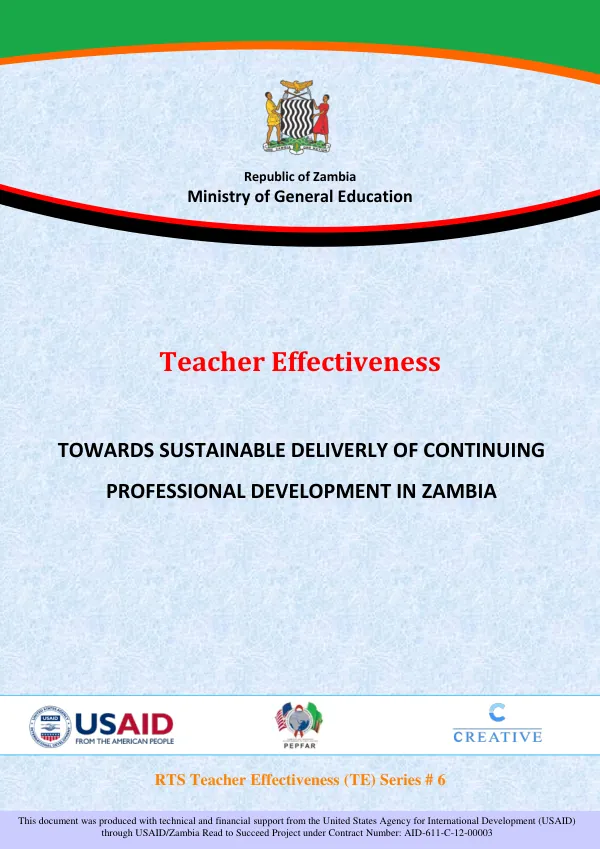
Towards Sustainable Delivery of Continuing Professional Development in Zambia
The Ministry of General Education in Zambia regards continuing professional development (CPD) as a vital process for teacher professional growth and an obligation for teachers.
2017 · 25 pages
Sign in to readA free account is required to download.
Abstract
This position is based on evidence of the important contribution that CPD makes to the enhancement of learner performance. In the past two decades, major strides have been made in institutionalizing and strengthening CPD in Zambia. The national education policy, Educating Our Future, emphasizes the importance of CPD in teacher education. The policy states that teacher education is a continuing process that must be extended throughout the individual's years of actual teaching. Teachers have a responsibility to deepen their knowledge, extend their professional skills, and keep themselves up-to-date on major developments affecting their profession. The national education policy also outlines the basic principles to underpin the strategic approaches to the provision of CPD. These principles include demand-driven programs, school-based programs, cascade models, cost-effective programs, and in-service courses for teachers and other field workers. Additionally, there are several policy frameworks in the education sector that provide direction to education service delivery, including the 2013 Education Curriculum Framework, the 2013 National Literacy Framework, and the 2015 National Numeracy Framework. The legal framework governing the teaching profession in Zambia has evolved over time. Until 2013, there was no law specifically governing the teaching profession. Teacher issues were either covered by provisions generally related to the public service or were tangentially referred to in the Education Act (1966). However, the Education Act has since been amended to provide a legal framework for the teaching profession. The Ministry of General Education regards in-service teacher training (INSET) as an indispensable aspect of the enhancement of teachers' knowledge and skills. INSET is seen as a critical component of the teacher's career and is essential for the overall quality of education. The Ministry has made significant strides in institutionalizing and strengthening INSET in Zambia, with a focus on school-based programs and cost-effective approaches. The Read to Succeed (RTS) project, implemented from 2012 to 2017, has played a significant role in promoting CPD in Zambia. The project has drawn on best practices and lessons learned over the past decade to develop a sustainable, cost-effective, and affordable CPD delivery approach for head teachers, deputy head teachers, and teachers at the primary education level. The approach focuses on school-based programs, cascade models, and in-service courses for teachers and other field workers. The report presents a comprehensive overview of the policy and planning framework, legal framework, institutional and structural arrangements, components and inputs, content of and approaches to CPD delivery, responsibilities in the delivery of CPD, and raising the profile of CPD in Zambia. The report aims to provide a sustainable, cost-effective, and affordable CPD delivery approach for the Ministry of General Education and other stakeholders in the education sector.
Related documents