CENTER FOR EDUCATIONAL DEVELOPMENT
Tracking and Tracing Books: A Grand Challenge for Development
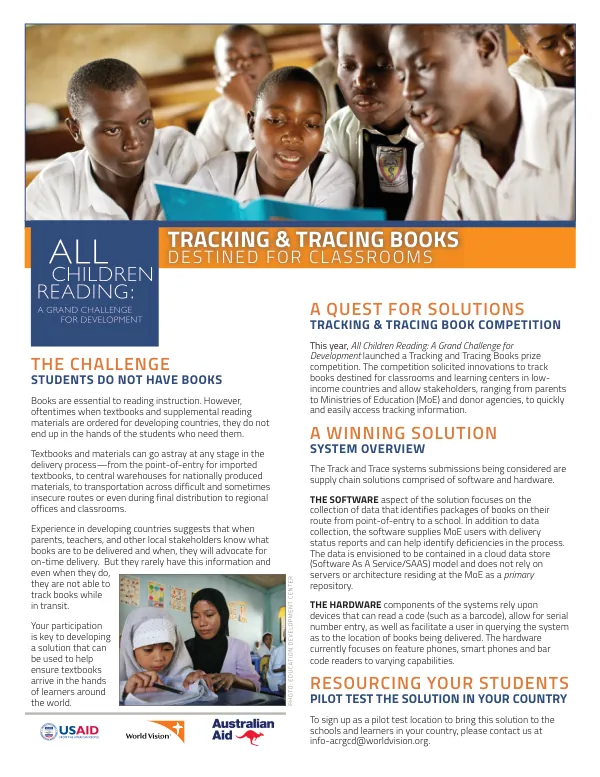
The Challenge of Ensuring Textbooks Reach Students in Developing Countries Ensuring textbooks reach students in developing countries is a significant challenge.
2 pages
Sign in to readA free account is required to download.
Abstract
Books are essential to reading instruction, but they often do not end up in the hands of the students who need them. The delivery process can be fraught with difficulties, from the point-of-entry for imported textbooks to central warehouses, transportation, and final distribution to regional offices and classrooms. In many cases, parents, teachers, and local stakeholders lack information about the books being delivered and when, making it difficult for them to advocate for on-time delivery. Tracking and Tracing Books in Developing Countries To address this challenge, the All Children Reading: A Grand Challenge for Development launched a Tracking and Tracing Books prize competition. The competition aimed to solicit innovations that could track books destined for classrooms and learning centers in low-income countries, allowing stakeholders to quickly and easily access tracking information. The competition received submissions for supply chain solutions comprised of software and hardware that could track books from point-of-entry to a school. Software Solutions for Tracking and Tracing Books The software aspect of the solutions focuses on collecting data that identifies packages of books on their route from point-of-entry to a school. The software supplies Ministries of Education (MoE) users with delivery status reports and can help identify deficiencies in the process. The data is envisioned to be contained in a cloud data store (Software As A Service/SAAS) model, which does not rely on servers or architecture residing at the MoE as a primary repository. This approach enables MoE officials to access tracking information remotely and efficiently. Hardware Components for Tracking and Tracing Books The hardware components of the systems rely on devices that can read a code, such as a barcode, allow for serial number entry, and facilitate a user in querying the system as to the location of books being delivered. The hardware currently focuses on feature phones, smart phones, and barcode readers with varying capabilities. These devices enable supply chain actors to confirm deliveries and provide stakeholders with up-to-date information on the status of books and educational materials. OpenEMIS Logistics: A Software Solution for Tracking and Tracing Books One of the solutions submitted to the competition is OpenEMIS Logistics, developed by the Community Systems Foundation (CSF). This open-source software tracks the delivery of textbooks to schools, leveraging existing OpenEMIS technologies to provide MoE officials with an integrated system for data collection, management, and analysis. The system allows local system administrators to manage users, subscriptions, and system configurations, while MoE officials can enter package and shipment details, including preferred routing. OpenEMIS Logistics also uses SMS and email alerts to send out and respond to queries from school personnel and parents. JSI's Software System for Tracking and Tracing Books Another solution submitted to the competition is JSI's software system, which combines functionality from three software solutions – Salesforce, TaroWorks, and an SMS provider – with the use of simple barcodes. This system supports the tracking and tracing of textbooks by education officials and enables parents, teachers, and local officials to receive up-to-date information on the status of books and educational materials. The system allows administrators to set up the user interface to reflect the structure of the education system, while MoE officials can place orders via the web interface, which generates a delivery note with a unique delivery identification number. Outcomes of Tracking and Tracing Books The tracking and tracing of books can have several outcomes, including improved coordination and communication among stakeholders, timely and cost-efficient delivery of books, and students having access to reading materials. Communities can be empowered to advocate for their children's education, and students can have more opportunities to practice reading. Additionally, tracking and tracing books can increase transparency and accountability in the delivery process.