USAID. MISSION TO INDIA
Trade in environmental services and technologies (TEST)
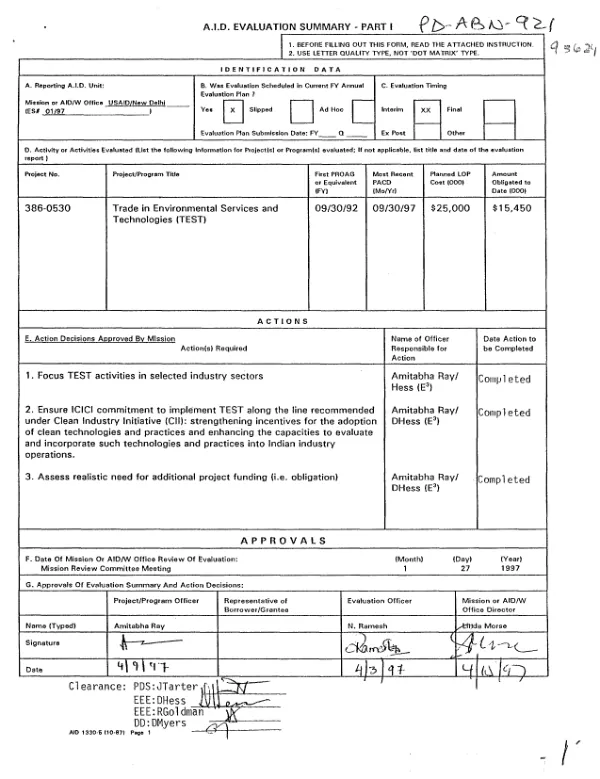
Summarizes evaluation (PD-ABN-695) of a project to help Indian industries adopt environmentally sound practices while promoting sustainable linkages between U.S.
1997
Sign in to readA free account is required to download.
Abstract
and Indian firms (TEST project). The project is being implemented by the Industrial Credit & Investment Corporation of India (ICICI) and Sanders International (SI). The mid-term evaluation, covering the period 9/32-3/96, was more of a planning tool than a traditional mid-term evaluation because it was conducted less than one year before the PACD and aimed to help the Mission redesign TEST as the Clean Technology Initiative (CTI/I), a new project due to begin in 1997. Both ICICI and SI have energetically met their commitments to the satisfaction of their beneficiaries. TEST has contributed toward the Mission"s Strategic Objective 5: "Improved air and water quality at selected industrial sites and municipalities". It will be a few years before the types of commercial transactions at the core of TEST"s design blossom, and the sustainability or failure of new partnerships and multiplier effects will become apparent. Detailed analysis of program impacts would take more time, information, and analysis than is anticipated in the TEST logical framework or was possible during this evaluation. Some management issues require the urgent attention of USAID and its institutional partners. (1) How should the pending loan applications be handled in order to minimize inconvenience to applicants and problems in program management? ICICI feels strongly that about $5-6 million should be awarded for loan applications currently in the pipeline. This would have major implications for the redesign of TEST because of the amount of money involved, unless this money would come from a source other than the funds projected for CTI/I. (2) How should the disruption between the end of SI"s contract on 1/31/97 and the beginning of the new TA contract be minimized? USAID expects to redefine the role of the U.S. institutional contractor for TEST and to award a new contract in early 1997. The following are lessons learned. (1) TEST should distinguish between markets for: new and/or growing, forward-looking industries; older, mostly medium- or small-scale industries; and environmental services. (2) A major financing component for TEST is no longer appropriate; there seems to be adequate financing in India for promising commercial transactions with environmental benefits, although ICICI disagrees with this conclusion. However, consideration should be given a limited financing component for demonstration projects of pollution abatement technologies that can readily be implemented on a wide scale, if the tested technologies prove environmentally and commercially viable. (3) Special commercial services provided to TEST participants have facilitated some commercial transactions, but there is no ready way to evaluate the cost-effectiveness of these services. Therefore, they should either become self-supporting or their environmental and economic merits should be evaluated to determine whether they are worth the extra cost. (4) CTI/I will present increased opportunities and needs for TEST to expand its partnerships, primarily with the U.S. Asian Environmental Partnership (USAEP) and a broader range of Indian institutions. (5) For some of the new measures to be adopted, TEST will need to shift from a demand-driven to a more targeted approach (e.g. by sector, region, or environmental issue) in order to enhance program implementation and performance monitoring of some CTI/I measures. (6) CTI/I should increase emphasis on how to design performance indicators and monitor performance. (i) As USAID already recognizes, Strategic Objective 5 needs to be re-evaluated in light of CTI/I. (ii) Performance indicators and the structure of performance monitoring should reflect the need for longer time horizons to evaluate project impacts. (iii) It is important to maximize learning from the initial three-plus years of TEST. (iv) USAID should structure reporting requirements for TEST to facilitate project monitoring and evaluation, and consider making tracking and analysis of TEST performance a performance indicator, at least for the next 2-3 years. Overall, the first phase of TEST occurred during a time of rapid change in India"s environmental market. The most important driving forces appear to be economic liberalization and globalization (for pollution prevention) and judicial activism linked to citizens" lawsuits (for upgrading of older facilities). USAID"s plans to redesign TEST for CTI/I are consistent with the results of this evaluation. Overall, the most crucial lesson learned for CTI/I may be the need to strengthen design, monitoring, and reporting for project indicators to enhance feedback for ongoing project improvement. This is particularly important since TEST is intended as a "cutting edge" project, with potential as a catalyst for other U.S. Government programs and other international donors. (Author abstract, modified)