AED
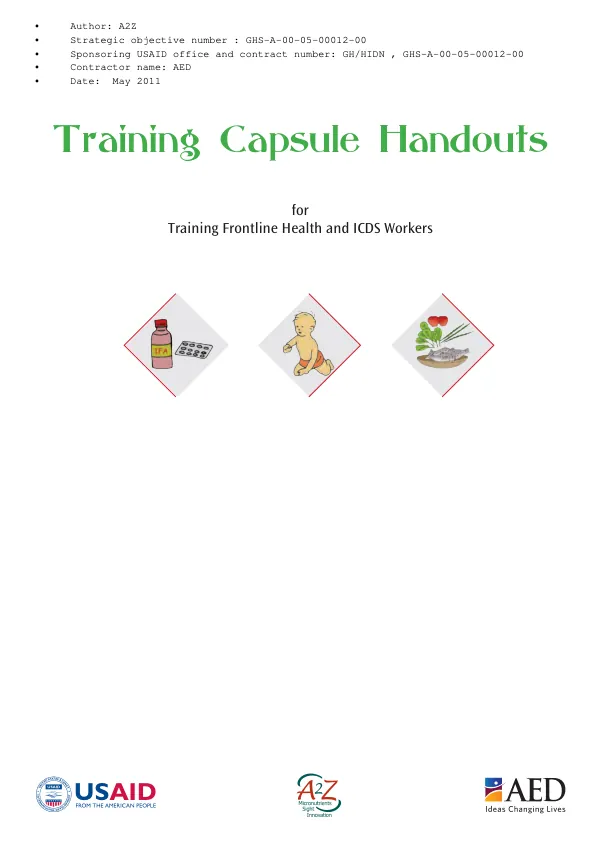
Training Capsule Handouts for Training Frontline Health and ICDS Workers
The Maternal and Child Anemia Control Strategy aims to reduce anemia in pregnant mothers and young children up to 59 months.
2011 · 20 pages
Sign in to readA free account is required to download.
Abstract
The strategy involves the participation of the health and ICDS sectors, with defined roles and responsibilities of the two sectors. Anemia in children can lead to poor development of the brain, reduced learning capacity, poor physical coordination and lethargy, loss of appetite and tiredness, and reduced ability of the immune system to fight diseases. Causes of anemia in children aged 6-59 months include inadequate intake of iron-rich food, occurrence of worms and malaria, and low iron stores at birth. To prevent and control anemia, children should be given iron and folic acid (IFA) syrup twice weekly, along with proper complementary nutrition. The de-worming dose should be given every six months from 12 months of age to 59 months. Nutrition counseling should be provided to caregivers, and children should be protected from malaria. Iron requirements are particularly high during pregnancy, adolescence, and childhood. In young children, particularly those aged 6-23 months, iron requirements are highest. Once birth iron reserves are exhausted at about six months, infants depend on weaning foods for iron because the iron content of human milk is not adequate to meet the increased requirements during the period of accelerated growth below two years. The Maternal and Child Anemia Control Strategy involves tasks to be performed by ANMs and ASHAs. ANMs will register all pregnant women and children, provide ANC and other services, and make IFA tablets and syrup available to AWWs and ASHAs. ANMs will also follow up on distribution and consumption of IFA tablets and syrup, and provide information about distribution and consumption in their monthly reports. ASHAs will fill all relevant information in Village Health Registers, enter the names of all pregnant women, and help them in getting ANC services through ANMs. According to statistics, anemia in children 6-35 months is prevalent in Jharkhand and Uttar Pradesh, with 78.2% and 85% prevalence rates, respectively. Pregnant women 15-49 years also suffer from anemia, with 68.4% and 51% prevalence rates in Jharkhand and Uttar Pradesh, respectively. Traditional complementary foods in these states are poor sources of bio-available iron, making children aged 6-23 months frequently iron deficient. The strategy aims to reduce anemia in pregnant mothers and young children up to 59 months through the participation of the health and ICDS sectors. ANMs and ASHAs will perform tasks to ensure the distribution and consumption of IFA tablets and syrup, and provide nutrition counseling to caregivers. The strategy will help to improve the health and well-being of pregnant mothers and young children in Jharkhand and Uttar Pradesh.