USAID
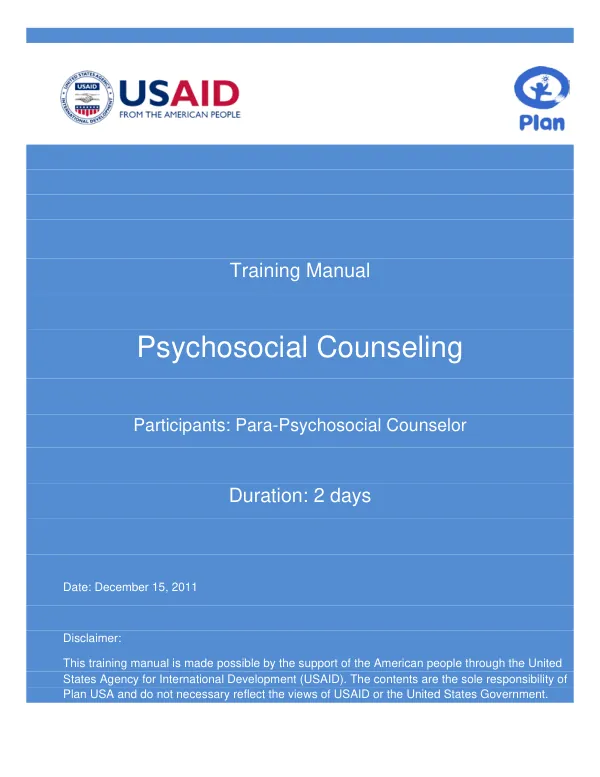
Training Manual: Psychosocial Counseling
The training manual for psychosocial counseling is designed to equip participants with the necessary skills and knowledge to provide counseling services to domestic violence survivors, particularly women and children.
2011 · 55 pages
Sign in to readA free account is required to download.
Abstract
The training is a 2-day program, scheduled to take place on December 15, 2011, and is implemented by Plan Bangladesh with the support of USAID. The training manual outlines the objectives of the training, which include enabling participants to explain the concept of body and mind, physical and mental health, and social values and culture. Participants are also expected to identify the types of discrimination faced by women and children, explain the social factors that influence human behavior, and describe the relationship between emotions, human behavior, and violence. The training manual is divided into 13 sessions, each with a specific topic and objectives. Session 1 focuses on inauguration, introduction, and objectives of the training, while Session 2 explores the concept of body and mind and physical and mental health. Sessions 3-5 delve into the topics of society, rituals, and socialization process, difference and discrimination between men and women, and values, culture, and human behavior. Sessions 6-8 cover the topics of emotion and expression of emotions, domestic violence, and its psychosocial causes, and the impact of violence against women and children. Sessions 9-10 focus on the concept of counseling and the qualities and ethics of a counselor. Sessions 11-13 cover the topics of standing for others, service delivery, and creating an action plan. The training manual also includes a pre-test and post-test to assess participants' knowledge and understanding of the topics covered. The pre-test includes questions on the mind and body, social factors that influence human behavior, and the relationship between emotions and violence. The post-test includes similar questions, as well as questions on the role of a psychosocial counselor in society and the type of service they can deliver in their area. The general objective of the training is to enable participants to perform as psychosocial counselors in their locality and deliver counseling services to domestic violence survivors. The specific objectives include enabling participants to explain the concept of body and mind, physical and mental health, and social values and culture, as well as identifying the types of discrimination faced by women and children and explaining the social factors that influence human behavior. Overall, the training manual provides a comprehensive framework for training psychosocial counselors to work with domestic violence survivors, particularly women and children. The manual outlines the objectives, topics, and activities for the training, as well as the expected outcomes and the role of the psychosocial counselor in society.
Related documents