USAID DEC
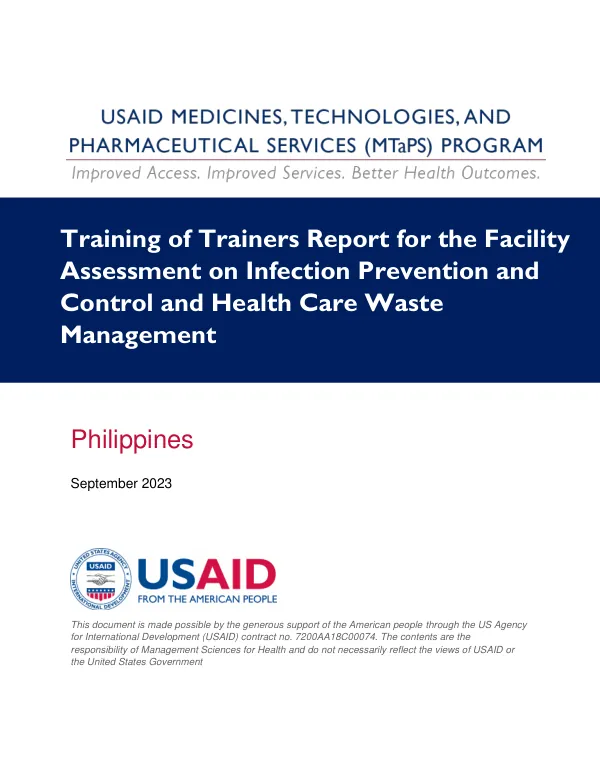
Training of Trainers Report for the Facility Assessment on Infection Prevention and Control and Health Care Waste Management
Sign inDELOITTE USA
Training of Trainers Report for the Facility Assessment on Infection Prevention and Control and Health Care Waste Management
The USAID Medicines, Technologies, and Pharmaceutical Services (MTaPS) Program is a global health initiative that aims to strengthen pharmaceutical systems in low- and middle-income countries.
2023 · 25 pages
Sign in to readA free account is required to download.
Abstract
The program focuses on improving access to essential medical products and related services, and on the appropriate use of medicines to ensure better health outcomes for all populations of target countries. The MTaPS approach builds sustainable gains in countries by including all actors in healthcare—government, civil society, the private sector, and academia. The program is implemented by a consortium of global and local partners and led by Management Sciences for Health (MSH), a global health nonprofit. The MTaPS Consortium includes a range of partners, including Boston University, FHI 360, Overseas Strategic Consulting, Results for Development, International Law Institute-Africa Centre for Legal Excellence, NEPAD, and others. The program is supported by the United States Agency for International Development (USAID) and is funded through a contract with USAID. In the Philippines, the MTaPS Program has supported the Department of Health (DOH) Health Facility Development Bureau (HFDB) in developing Training of Trainers (ToT) modules/materials to help cascade the new standards for Health Care Waste Management and Infection Prevention and Control. The source of module development is based on the Health Care Waste Management (HCWM) manual 4th edition and Infection Prevention and Control (IPC) manual 3rd edition. The target participants are health personnel from the Centers for Health Development (CHDs) of each region who will be responsible for cascading the training to their respective health facilities. A total of forty-one (41) health personnel were trained in 17 regions, with 16 males and 25 females. The training was conducted over five days, from September 19 to 23, 2022. The training covered a range of topics, including an overview of the HCWM manual 4th edition, national standards in infection prevention and control for health facilities, adult learning principles, and teach-back instructions. The training also covered HCWM source, categorization, characterization, minimization, segregation, collection, storage, and transport, as well as HCWM organizations, functions, roles, and responsibilities. The training results showed that the participants demonstrated a good understanding of the HCWM and IPC standards. The analysis of pre-test and post-test results showed a significant improvement in the participants' knowledge and skills in HCWM and IPC. The training was conducted in a participatory manner, with facilitation techniques and interactive learning methodologies used to engage the participants. The training also included a teach-back session, where participants were required to demonstrate their understanding of the HCWM and IPC standards. The MTaPS Program has made significant contributions to the development of the HCWM and IPC standards in the Philippines. The program has supported the DOH HFDB in developing ToT modules/materials, which will help cascade the new standards to health facilities across the country. The program has also trained health personnel from the CHDs of each region, who will be responsible for cascading the training to their respective health facilities. The program's efforts will contribute to the improvement of healthcare waste management and infection prevention and control practices in the Philippines, ultimately leading to better health outcomes for the population.
Related documents