WORLD HEALTH ORGANIZATION
Transition to a National Health Service in Albania
The transition to a National Health Service in Albania is a complex process that requires careful consideration of various characteristics and options.
2013 · 3 pages
Sign in to readA free account is required to download.
Abstract
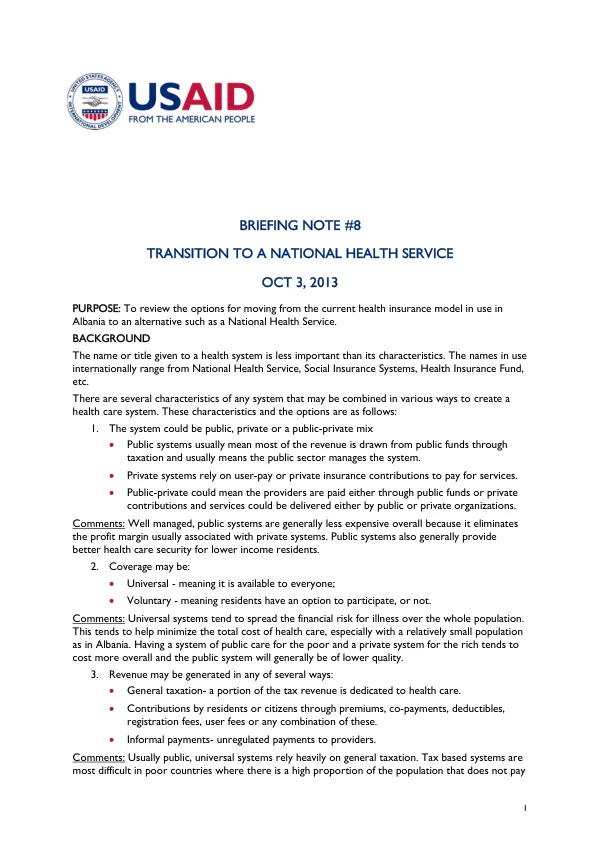
A public health system is generally less expensive overall because it eliminates the profit margin associated with private systems. Public systems also provide better health care security for lower-income residents. The system could be public, private, or a public-private mix. Public systems rely on public funds through taxation, while private systems rely on user-pay or private insurance contributions. A public-private mix means providers are paid through public funds or private contributions, and services are delivered by public or private organizations. Universal coverage is available to everyone, while voluntary coverage is optional. Universal systems spread the financial risk for illness over the entire population, minimizing the total cost of health care. Having a system of public care for the poor and a private system for the rich tends to cost more overall and results in a lower-quality public system. Revenue may be generated through general taxation, contributions by residents or citizens, or informal payments. Public, universal systems rely heavily on general taxation, which is the best option for poor countries with a high proportion of the population that does not pay taxes. Most European countries have a public system with most of the revenue coming from taxation, supplemented by premiums, registration fees, or co-payments. Provider funding or reimbursement can be through salary, fee for service, payment for cases, or budget allocation. The method of funding providers is not constrained by the type of health care system, and each has its advantages and disadvantages. Salary offers cost control and a method to direct care where it is needed, while fee for service and case payment systems tend to cause an increase in service delivery and expenditures. Budget allocation on a line-by-line basis offers the best control of expenditures but minimizes innovation, efficiency, and effectiveness of care management. Regardless of the combination of characteristics chosen for the system in Albania, the same type of organization is required to manage the system. This organization will require dedicated staff with specific education, experience, and skills to oversee operations. In many countries, organizations separate from the Ministry of Health are created for this purpose, as Ministries are often large bureaucracies that are unable to respond quickly to change policies, adjust to new technologies, and hire the staff needed to manage the system. The functions of the Health Insurance Institute, such as registration of people who are covered, supervision and funding of providers, and collection of information and analysis of services, will need to be provided by any replacement organization. If Albania eliminates payments by patients, it will lose about 60 million Euros of the total 260 Euros spent on health care, which will need to be acquired from other sources. In Albania, there has been a history of hiring or appointing staff to both senior and junior positions based on personal or political connections, resulting in poor management, inefficiency, and loss of funds to corruption. Hospital directors are often unqualified for their positions, serve for short periods, and have no commitment to the long-term improvement of the hospitals. Appointments in health care should be based on a transparent selection process based on merit and open competition, with education, experience, and commitment being the criteria for selection. People hired should be made accountable for their performance. It is recommended that any name could be adopted for the health system in Albania, and characteristics could be a combination of public, private, or public-private mix. A tax-based system is best, and because tax revenue is limited, other forms of contributions may be required. Primary care provider compensation and organization is best organized as it is presently. Hospital funding should move from the current historical and line-by-line allocation system to a more equitable global budgeting and population-based model. Before global budgets are adopted, there should be a governance system in hospitals to oversee hospital management and minimize political interference. Hospital managers and HII staff should be selected through open competitions based on their experience, education, and skills. Informal payments should be strictly prohibited.