MINISTRY OF HEALTH
Improving Hospital Performance & Access to Quality Care
Improving Hospital Performance and Access to Quality Care is a critical challenge for governments worldwide.
2014 · 3 pages
Sign in to readA free account is required to download.
Abstract
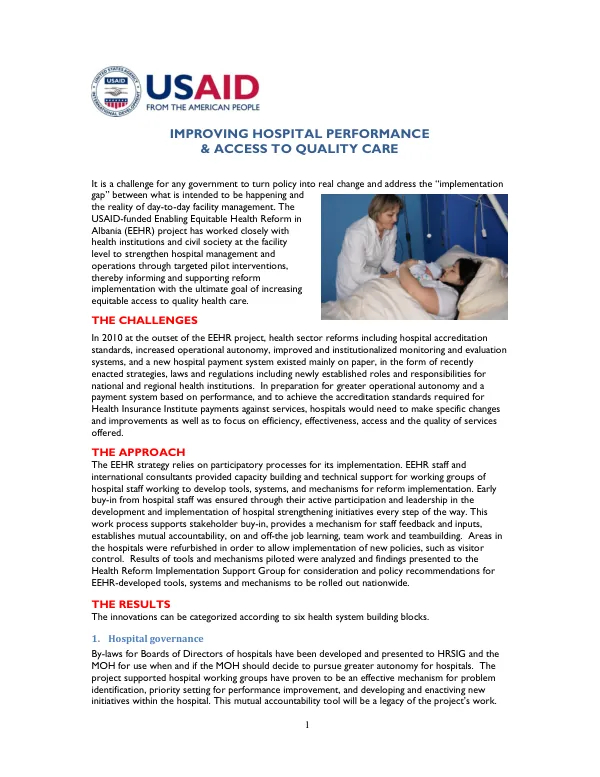
The USAID-funded Enabling Equitable Health Reform in Albania (EEHR) project has worked closely with health institutions and civil society to strengthen hospital management and operations through targeted pilot interventions. The ultimate goal of the project is to increase equitable access to quality health care. At the outset of the EEHR project in 2010, health sector reforms including hospital accreditation standards, increased operational autonomy, improved and institutionalized monitoring and evaluation systems, and a new hospital payment system existed mainly on paper. In preparation for greater operational autonomy and a payment system based on performance, hospitals needed to make specific changes and improvements, focusing on efficiency, effectiveness, access, and the quality of services offered. The EEHR strategy relies on participatory processes for its implementation. EEHR staff and international consultants provided capacity building and technical support for working groups of hospital staff to develop tools, systems, and mechanisms for reform implementation. Early buy-in from hospital staff was ensured through their active participation and leadership in the development and implementation of hospital strengthening initiatives. This work process supports stakeholder buy-in, provides a mechanism for staff feedback and inputs, establishes mutual accountability, and promotes on and off-the-job learning, teamwork, and teambuilding. The project has achieved significant results in six key areas of the health system building blocks. Hospital governance has been strengthened through the development of by-laws for Boards of Directors of hospitals, which have been presented to the Health Reform Implementation Support Group and the Ministry of Health for use. The project-supported hospital working groups have proven to be an effective mechanism for problem identification, priority setting for performance improvement, and developing and enacting new initiatives within the hospital. Health finance has been improved through the introduction and testing of procedures and rules to support a new performance-based hospital payment system. Hospital finance staff has been trained on applying the new hospital payment method, and cost-accounting studies have been conducted at three pilot hospitals, demonstrating cost-allocation techniques for advanced hospital management. Staff of the hospitals has been trained on step-down cost-accounting approaches and understands how to use it to support hospital management decision-making. Service delivery has been enhanced through the adoption of numerous policies, practices, and procedures to improve the quality of services, patient comfort and safety, efficiency, and infection control. Hospitals have implemented incident reporting policies, visitor control policies, and outsourcing of non-clinical services, contributing to infection control. The pilot hospitals have created a separate department for environmental services, which professionalizes the function and provides it with standards of performance. Human resources have been strengthened through the development of a set of tools, manuals, policies, training programs, and capacities of health professionals working at pilot hospital Human Resource Departments. The project has supported the implementation of at least 12 Human Resource Components, including job descriptions, new employee orientation, performance monitoring and planning, training needs assessment and training plans, employee transfer and promotion, and others. Health information systems have been improved through the implementation of the Astraia OB/GYN software at two pilot hospitals, enabling them to run more efficient operations with higher software utilization levels. Staff of pilot hospitals have well-designed color-coded ID badges that enable visitors and patients to identify easily hospital employees by their name and position. The regional hospital in Lezha has telemedicine equipment and a furnished telemedicine room, enabling the hospital to be part of the telemedicine/teleconsultation network in Albania. Pharmaceutical and medical supply management has been strengthened through the establishment of Pharmacy and Therapeutics Committees that monitor the adherence to an approved formulary and are responsible for the proper planning and forecasting of pharmaceutical needs. Procedures have been put in place to guide drug dispensing, and the refurbished pharmaceutical warehouse at Lezhe Regional Hospital is now the central location for storage, allowing for greater control and accountability over the management of drug disbursement and reordering. In the long term, one of the most important achievements among the hospitals is that they now have the systems in place for continuous improvement and the capacity to use the tools listed above. Most training courses have been certified for Continuing Medical Education, providing ample opportunity for trained professionals to train others using the EEHR materials. Hospital teams are capable of interacting and supporting each other in a way that breaks internal/vertical silos and advances hospital improvement through collaboration and integration. Soft skills such as presentation, team building, and leadership skills have been improved and made a part of the toolset available to hospital human resources.
Related documents